Amazon gives $1B away every year.
Every business thinks they're selling a product.
They're wrong.
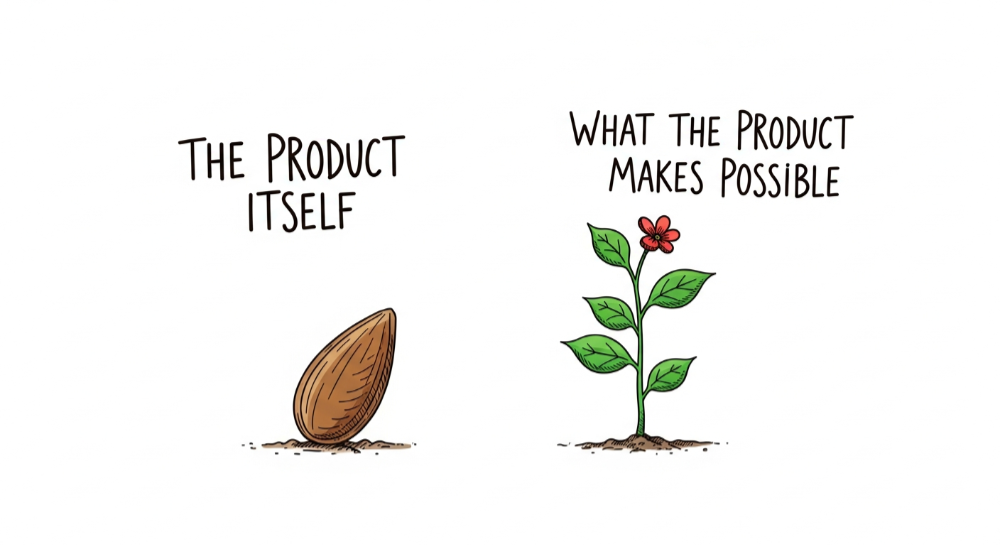
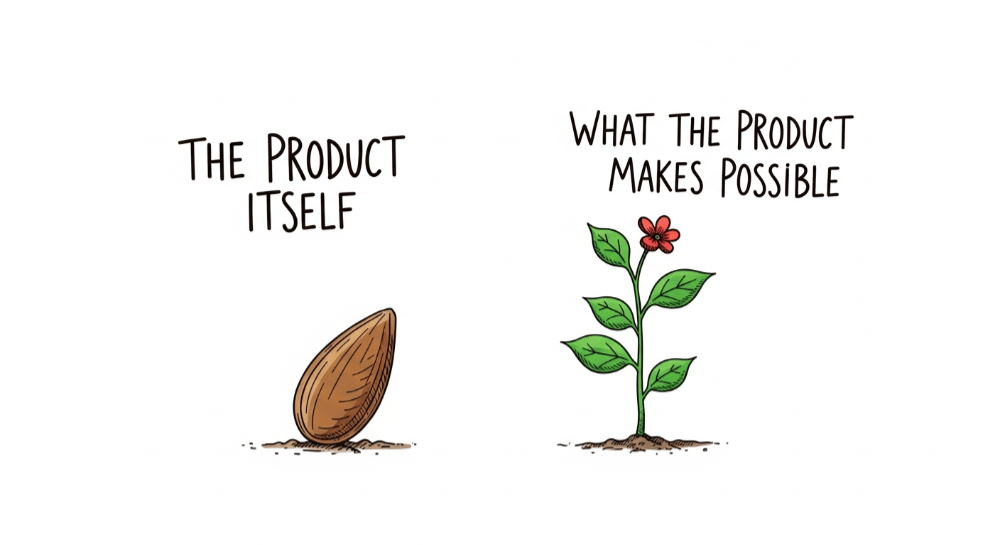
They're selling a future. A transformed state. A possibility that didn't exist before.
The product is just the artifact. The receipt. The thing that sits in a folder somewhere, unopened, while the real value compounds in ways no deliverable can capture.
This is the hidden logic behind the most valuable companies on the planet. And it's the insight that changed how I run my own business.
Let me show you what I mean.
THE MOMENT I REALIZED I WAS IN THE WRONG BUSINESS
A few years ago, an edtech company hired me for brand strategy.
They were about to take some massive risks. The kind of bold moves that either define a category or become cautionary tales. They wanted someone to build the foundation.
So I did what strategists do. Built the framework. Developed the positioning. Created the campaign roadmap.
Three months in, we were reviewing progress. I asked about the strategy document.
"Oh," the founder said.
"I'm not sure where that is. Maybe Google Drive?"
The engagement was a success. The risks worked. The brand broke through.
But no one had opened the strategy document since month two.
I could have been offended. Instead, I got curious. If they weren't using the document, what were they using?
The answer changed everything.
They were using me.
Not my deliverable. Me.
The strategy document was the excuse. The real product was having one sane person in the room while they took crazy risks. Someone who could look at their wildest ideas and say, "Here's how we make this work."
I wasn't selling strategy. I was selling the possibility of confident risk-taking.
The document was the artifact. The possibility was the product.
Easy setup, easy money

Your time is better spent creating content, not managing ad campaigns. Google AdSense's automatic ad placement and optimization handles the heavy lifting for you, ensuring the highest-paying, most relevant ads appear on your site.
THE COMPANIES THAT UNDERSTAND THIS
Once you see this pattern, you can't unsee it.
Amazon Web Services (AWS) gives away nearly $1 billion in credits every year, which is free infrastructure for startups.
Why?
Because 80% of the world's unicorns run on AWS. Every startup that got free credits and became a billion-dollar company now pays millions annually for the infrastructure they built on.
The credits aren't the product. The credits are the wedge. What the credits make possible, entire companies that couldn't exist without scalable infrastructure --- that's the product.
Canva has 260 million monthly users. $3.5 billion in annual revenue.
Canva has never designed anything.
Every design on Canva was made by someone else. Canva just made it possible. They turned "I'm not a designer" into "I just designed this."
The tool isn't the product. The capability isn't even the product. The identity shift, from non-designer to designer --- that's the product.
Stripe and Twilio are billion-dollar companies built on APIs. Lines of code that do one thing: make other things possible.
Stripe makes it possible to accept money with a few lines of code. Twilio makes it possible to build communication into anything.
They don't sell features. They sell removal of friction. The distance between "I have an idea" and "I'm getting paid for it" just collapsed. The distance between "I need to call my customers" and "I'm calling my customers from my app" just collapsed.
That collapse --- that's the product.
THE POSSIBILITY HIERARCHY
Here's the framework. I call it The Possibility Hierarchy.
Most businesses operate at Level 1. The most valuable operate at Level 5.
Level 1: The Artifact
The tangible deliverable. The thing with a name and edges.
→ A strategy document. A SaaS subscription. A line of code. A designed logo.
Level 2: The Capability
What the artifact enables someone to DO.
→ Make informed decisions. Accept payments. Design graphics. Send messages at scale.
Level 3: The Confidence
What the capability makes them FEEL.
→ Safe to act. Competent to compete. Ready to scale. Willing to risk.
Level 4: The Behavior Change
What the confidence makes them DO differently.
→ Take bigger bets. Move faster. Invest more. Attempt things they wouldn't have before.
Level 5: The Transformed Future
What their changed behavior makes POSSIBLE.
→ Category leadership. Exponential growth. Market dominance. Legacy.
The gap between Level 1 and Level 5 is where all the real value lives.
AWS sells at Level 5. Server credits (Level 1) → Build without infrastructure limits (Level 2) → Confidence to scale (Level 3) → Attempt rapid growth (Level 4) → Build billion-dollar companies (Level 5).
Canva sells at Level 5. Design software (Level 1) → Create professional visuals (Level 2) → Feel like a designer (Level 3) → Create your own marketing (Level 4) → Professional brand presence without hiring designers (Level 5).
That edtech company paid me at Level 5. Strategy document (Level 1) → Strategic framework (Level 2) → Confidence in the plan (Level 3) → Take bold market risks (Level 4) → Category breakthrough (Level 5).
THE DIAGNOSTIC: WHAT LEVEL ARE YOU SELLING?
Let me ask you some uncomfortable questions.
Question 1: How do you describe your work?
- If you describe deliverables, you're selling at Level 1.
- If you describe capabilities, you're selling at Level 2.
- If you describe confidence, you're selling at Level 3.
- If you describe behavior change, you're selling at Level 4.
- If you describe transformed futures, you're selling at Level 5.
Most professionals sell at Level 1. "I deliver strategy." "I build websites." "I write code."
That's fine.
But you'll always be competing with everyone else who delivers strategy, builds websites, and writes code.
Question 2: What's your 100x gap?
What do you charge for your work?
Now: What's the value of what your work makes possible?
If you charge $10,000 for work that makes a $1,000,000 outcome possible, you have a 100x gap.
That gap is either:
- An opportunity (you could capture more value)
- A strategy (you're using it as a wedge to bigger things)
- A problem (you don't understand your own value)
Question 3: What would your clients never attempt without you?
This is the real question.
What do they ATTEMPT because of what you represent?
For me, the answer became clear, my clients attempt things they'd otherwise consider too risky. They made market moves that make competitors nervous.
The document is the artifact. The risk tolerance is the product.
WHY MOST PEOPLE GET THIS WRONG
There's a reason most businesses, consultants, and creators sell at Level 1.
It's safer.
Products are tangible. You can point at them. You can compare them. You can put them in a contract and say, "Hey, this is what you get."
Possibilities are scary. They're intangible. They require trust. They force you to make promises about outcomes you can't fully control.
But the best companies figured out that the more intangible your value, the more defensible your position.
Anyone can copy a product. No one can copy the possibility you represent.
Stripe's code could theoretically be replicated. The possibility of effortless payments and the trust that Stripe represents cannot be.
Canva's features could be duplicated. The possibility of creative confidence for non-designers, the identity shift Canva enables, cannot be.
My strategy frameworks could be stolen. The possibility of having one sane person in your corner while you take risks --- that's irreplaceable.
The thing that feels hardest to sell is actually the thing that's hardest to compete with.
When you sell at Level 1, you're in a race to the bottom. Better features.
When you sell at Level 5, you're in a category of one. No one else can offer the exact future you make possible.
THE POSITIONING
This insight is why I call myself the stupidpreneur.
I work with businesses that want to stand out instead of fit in. Companies that have wild ideas but need someone slightly sane to make them work in the market. Not to make them safe, but to make them survive contact with reality.
This positioning does something important; it describes Level 5 value, not Level 1 deliverables.
"Brand strategist" describes deliverables. "Stupidpreneur" describes what becomes possible.
THE CAREER APPLICATION
This isn't just for businesses. It's also for careers.
What do you make possible?
A manager doesn't deliver task assignments. They make initiative safe, growth possible, and autonomy rewarded.
A teacher doesn't deliver information. They make curiosity rewarding, mistakes productive, and learning sustainable.
A consultant doesn't deliver recommendations. They make bold decisions defensible, strategic risks intelligent, and ambitious visions achievable.
A developer doesn't sell code. They sell the possibility of ideas becoming real.
A designer doesn't sell visuals. They sell the possibility of being understood at first glance.
If I were you, here is how I'd reframe things:
Old question: What do I do?
New question: What becomes possible because I exist?
Old question: What are my deliverables?
New question: What futures do my clients build that they couldn't build without me?
Old question: What should I charge?
New question: What's the value of what I make possible?
That edtech company didn't hire me for a strategy document. They hired me for permission. For validation. For the confidence that comes from having someone in your corner who gets what you're trying to do.
WHY THE BEST COMPANIES GIVE THINGS AWAY
The companies that understand the Possibility Hierarchy often give away the lower levels for free.
AWS gives away credits (Level 1). Captures value at Level 5 (billion-dollar company infrastructure).
Canva gives away the basic tool (Level 1). Captures value at Level 5 (professional brand presence for teams).
Stripe charges almost nothing on transactions (Level 1). Captures value at Level 5 (owning the commerce layer of the internet).
They understand that the artifact is the wedge, and the possibility is the product.
This is why "freemium" works. This is why content marketing works. This is why giving away knowledge builds consulting businesses.
You're not giving away the value. You're giving away the artifact to capture the possibility.
SIGNS YOU'RE SELLING AT THE WRONG LEVEL
How do you know if you're stuck at Level 1 when you should be selling at Level 5?
Here are the warning signs:
You compete on price.
When clients compare you to competitors based on cost, you're selling at the artifact level. At Level 5, price comparisons don't make sense, you're not selling the same thing as anyone else.
You get asked for revisions, not results.
When clients focus on the deliverable itself ("Can you change this section?") rather than the outcome ("Will this help us achieve X?"), you've positioned yourself as an artifact producer, not a possibility enabler.
Your proposals describe activities.
"We will conduct research, develop a framework, and deliver a report." That's Level 1. Level 5 sounds like, "You'll be able to make $10M decisions with confidence."
Clients don't refer you.
When you sell artifacts, clients say, "They delivered a good strategy." When you sell possibilities, clients say, "They changed how we think about risk." One of those generates referrals. The other doesn't.
You feel replaceable.
If you worry that a cheaper freelancer or an AI tool could do what you do, you're selling at the wrong level. No one can replace the specific possibility you represent.
The fix isn't to work harder on your deliverables. It's to climb the hierarchy, to understand and communicate the transformation your work enables.
THE PRICING IMPLICATION
This changes how you think about money.
Level 1 pricing is cost-plus. What does it take to produce this deliverable? Add a margin. That's your price.
Level 5 pricing is value-based. What does the transformed future look like for your client? What's that worth to them? Price as a fraction of that value.
Here's a concrete example:
A brand strategy document takes me about 40 hours to produce. At Level 1 pricing, let's say $200/hour --- that's $8,000.
But what does that strategy make possible? For the edtech company, it enabled a market move that captured significant share in a competitive category.
The possibility? Worth millions.
I'm not saying I charge millions. I'm saying the conversation changes entirely when you understand the gap between the artifact's cost and the possibility's value.
Clients who understand they're buying a $10M possibility don't haggle over $50K. Clients who think they're buying a strategy document absolutely will.
THE PLATFORM LESSON FOR NON-PLATFORMS
You might be thinking, "Great, but I'm not AWS. I'm not building a billion-dollar platform."
Fair.
But the thinking still applies.
Even if you're a solo consultant, a freelancer, or a small agency, you can think in possibilities instead of deliverables.
Positioning: Describe the future you make possible, not the work you deliver.
Pricing: Price based on the value of the possibility, not the cost of the artifact.
Marketing: Share the transformation, not the process.
Sales: Sell the destination, not the vehicle.
It changes who you're competing against.
AWS isn't competing with other cloud providers. They're competing with the question "Should I build this myself?" And they win by making the alternative feel impossible.
Canva isn't competing with Adobe. They're competing with "I can't design." And they win by making that statement feel outdated.
When you sell at Level 5, you're not competing with others who do what you do. You're competing with the version of your client's life where you don't exist. And you win by making that version feel unacceptable.
THE COMPOUNDING NATURE OF POSSIBILITY
One more thing.
Possibilities compound in ways deliverables don't.
That edtech company took one big risk with me as a safety net. It worked. Now they take big risks as standard operating procedure. They don't need me for every decision, but that first possibility unlocked a permanent expansion of what they believe they can do.
AWS enabled Netflix to stream at scale. That possibility, once proven, changed what every media company believed was achievable. Streaming became the default. AWS made an entire industry possible.
Canva enabled millions of non-designers to create professional visuals. That possibility, once proven, changed what every small business believed about in-house capability. The marketing team stopped waiting for designers.
When you sell possibilities, you don't just change what someone does. You change what they believe they can do.
That belief outlasts any deliverable.
YOUR POSSIBILITY AUDIT
I'll leave you with a practical exercise.
- Step 1: List your deliverables. What do you actually hand over?
- Step 2: Map each deliverable to a capability. What can they do because of it?
- Step 3: Map each capability to a confidence. What do they feel safe attempting?
- Step 4: Map each confidence to a behavior change. What do they actually do differently?
- Step 5: Map each behavior change to a transformed future. What becomes possible in their life or business?
- Step 6: Look at the gap. Where are you positioning? Where are you pricing? Where should you be?
THE BOTTOM LINE
The product was never the product.
The deliverable was never the value.
What you make possible --- that's where the real leverage lives.
AWS figured this out. Canva figured this out. Stripe figured this out.
Every time you think about your business, your career, or your offering, ask:
"What becomes possible because of me?"
Answer that question honestly, and you'll understand your real value.
Answer it compellingly, and you'll never compete on price again.
Answer it consistently, and you'll build something no one can copy.
The product was never the product.
The possibility was the product all along.
Stay a little stupid,
Shashank
Your Stupidpreneur
P.S.
What's the biggest decision a client made AFTER working with you that they wouldn't have made before? That's your Level 5 value.
P.P.S.
When prospects default to price, it's not because you're expensive. It's because your positioning is unclear.
Click here and get your free 5-day brand diagnosis.
11, PNR Nagar
Dindigul, Tamil Nadu 624001, India

No comments yet. Be the first to comment!