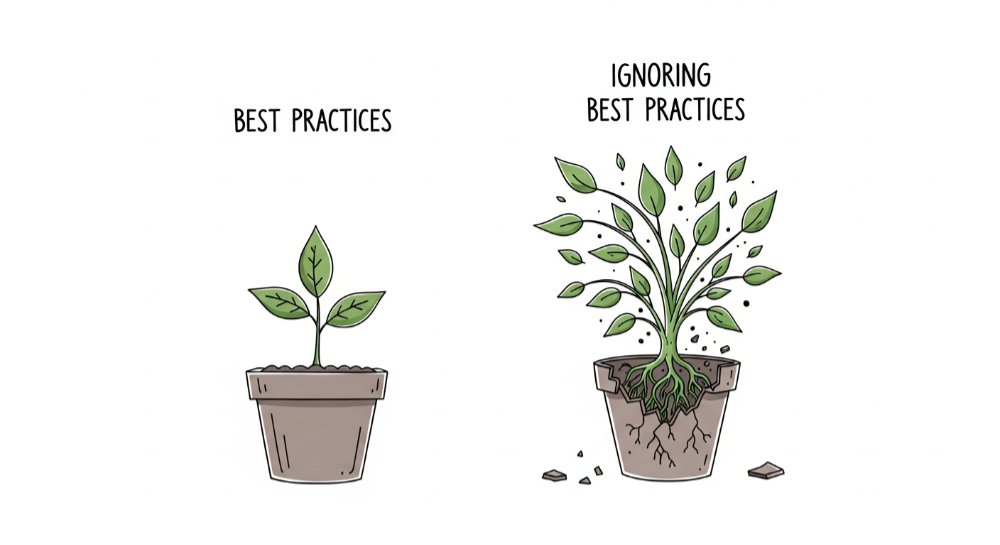
Best practices are a trap
A few months ago, a friend asked me to review his startup's go-to-market strategy. He'd done everything right. Hired the growth consultants. Read the playbooks. Implemented the "proven frameworks."
But his marketing looked exactly like his competitors'. His positioning was indistinguishable and the pricing followed industry benchmarks.
"So what's the problem?" he asked.
"You have no problem," I said. "You also have no advantage."
Best practices are a trap. They're the default settings of business strategy. And in a world where everyone has access to the same information, following best practices means becoming interchangeable.
The companies that build lasting moats do something different: they treat industry consensus as a signal to investigate, not a playbook to follow.
The best practices paradox
"Best practices" sounds safe. Scientific, even. It's what works. It's been proven.
But a best practice is really just the most common approach among your competitors.
When you adopt a best practice, you're not gaining an advantage. You're eliminating a disadvantage. You're achieving parity. You're running the same operating system as everyone else.
Best practices often become industry standards because they're safe. They spread through mimicry and the original context gets lost.
And then someone comes along who refuses to follow them.
Patagonia: the anti-consumption brand
The marketing best practice is to maximize purchase intent. Never give customers a reason not to buy. Black Friday is for pushing products.
On Black Friday 2011, Patagonia ran a full-page New York Times ad with their best-selling jacket and a simple headline: "Don't Buy This Jacket."
The ad detailed the environmental cost of manufacturing, the waste, and the resources consumed. It explicitly asked customers to think twice before purchasing.
This is marketing malpractice by any traditional standard. You don't suppress demand. You don't highlight negatives. You don't tell people to stop shopping.
Patagonia's revenue increased 30% over the following nine months. A 40% surge over two years.
Trust is scarce. In a world where every brand is screaming for attention, the one that respects your intelligence becomes unforgettable. Patagonia wasn't selling jackets. They were selling a relationship with a company that wouldn't treat you like a mark.
So did Netflix and Costco.

The pattern beneath the stories
These companies aren't randomly rebellious. They share a diagnostic framework.
First, identify the unquestioned assumptions. Every industry has beliefs so deeply embedded they're invisible. "Retail is a margin game." "Tech giants must diversify." "Marketing should drive consumption." These assumptions aren't always wrong. But they're rarely examined.
Second, trace the assumption to its origin. Best practices usually solved real problems in a specific context, at a specific time. Retail margins mattered when differentiation was possible. Diversification made sense when industries were more siloed. But contexts change. The practice often outlives its purpose.
Third, ask the inversion question: what if we did the exact opposite? Most inversions are stupid. Some unlock enormous value.
Fourth, identify the hidden advantage. Anti-default strategies only work when the opposite behavior creates a new source of competitive advantage. Costco's high wages drive retention. Netflix's focus enables mastery. Patagonia's restraint builds trust.
The self-diagnostic
This is where it stops being about other companies.
List five things your company does because "that's how it's done in this industry."
For each, answer: why does this practice exist? What problem was it originally solving? Is that problem still relevant?
For at least one, genuinely explore the inversion. As an actual strategy option. What would have to be true for the opposite approach to work?
Where does the inversion create a hidden advantage?
If you can't answer these questions, you're running on defaults. And somewhere, right now, a competitor is asking them.
The only advantage left
The tools are commoditized. The playbooks are public. The data is available to everyone.
Your competitors can copy your tech stack in a week. They can replicate your marketing tactics in a month. They can match your pricing by tomorrow.
What they can't copy is the courage to reject industry consensus when that consensus has become a trap.
Netflix didn't have better streaming technology than Blockbuster. Costco doesn't have superior warehouses to Sam's Club. Patagonia doesn't have access to manufacturing capabilities that North Face lacks.
They have a different relationship with best practices. They treat "the way things are done" as a hypothesis to test, not a rule to follow.
That's the only sustainable advantage in a world of tool parity. Everyone has access to the same resources. Very few have the nerve to use them differently.
Shashank
P.S.
The safest thing you can do in business is follow best practices. It's also the fastest way to become irrelevant. Safety and differentiation pull in opposite directions. Pick one.
P.P.S.
Worth remembering: when Costco decided to pay workers nearly double the industry average, retail analysts called it "unsustainable." When Netflix bet $100M on original content, entertainment executives called it "reckless." When Patagonia told customers not to buy on Black Friday, marketing experts called it "insane." The people most invested in existing defaults are always the most certain that alternatives won't work.

No comments yet. Be the first to comment!