Data-Driven Marketing is a Trap
A founder showed me his analytics dashboard last month and it was one of the best ever dashboards that I have ever seen in my life. It had everything:
- Beautiful charts.
- Every metric that a business could possibly track.
- A/B tests running on his headline
- CTA button color
- Email subject lines.
But revenue? Flat for 18 months.
"I don't understand," he said. "I'm doing everything the data tells me."
THE REARVIEW MIRROR PROBLEM
Data only shows you what already happened.
Data is a rearview mirror. It tells you which road you've been on. It cannot tell you which road to take next, especially if that road doesn't exist yet.
When you're "data-driven," you're optimizing for the past. You're making small improvements to a direction that might be fundamentally wrong.
The biggest wins in business don't come from 2% conversion improvements. They come from zigging when everyone else zags.
Data can't tell you when to zag.
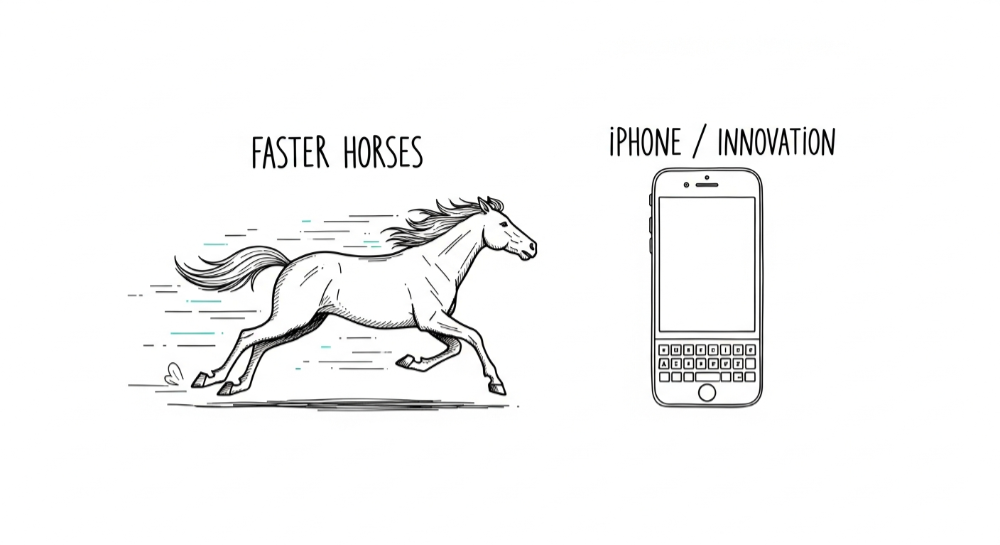
THE "FASTER HORSES" PRINCIPLE
Henry Ford allegedly said: "If I had asked people what they wanted, they would have said faster horses."
Whether he actually said it doesn't matter. The insight is real.
Customers can articulate problems. They cannot articulate solutions they've never imagined. Data captures what people do , it cannot capture what people could do if you showed them something new.
The iPhone didn't come from market research. Steve Jobs famously refused to use focus groups. His reasoning? "People don't know what they want until you show it to them."
Jobs killed the stylus when every data point said people wanted one. He removed the keyboard when BlackBerry's data said keyboards were essential.
Steve was right and the data was wrong by trillions of dollars.

WHEN GUT BEATS SPREADSHEET
I'm not saying ignore data. I'm saying know its limits.
Use data for:
- Validating what's already working (double down)
- Identifying what's broken (fix or kill it)
- Measuring progress on a known path
Use gut for:
- Choosing which path to take
- Deciding what to build next
- Making bets the market hasn't validated yet
The founder with the beautiful dashboard? His data was optimizing a product nobody wanted. No amount of A/B testing would fix that. He needed to make a gut decision about a new direction, something no spreadsheet could give him.
THE "INSIGHT VS. INFORMATION" SPLIT
Data gives you information. Gut gives you insight.
Information: "Bounce rate is 67% on mobile." Insight: "Our entire value proposition is wrong for this audience."
Information tells you what . Insight tells you why and what next.
The best founders I've worked with use data to confirm intuition, not replace it. They have a thesis about the market, then look for data to stress-test it. They don't wait for data to hand them a thesis.
THE DIAGNOSTIC
Answer honestly:
When's the last time you made a significant business decision that your data couldn't justify?
If every decision requires a spreadsheet, you're not leading. You're following --- following what already happened, hoping it predicts what's next.
Sometimes it doesn't.
Trust the gut.
Your brand strategist,
Shashank SN
Fractional Chief Brand Officer
P.S.
The most "data-driven" company I ever saw went bankrupt optimizing a product nobody wanted. They had dashboards for everything except the question that mattered: "Should we be doing this at all?"
P.P.S.
If your marketing team says "the data says..." more than "I believe...", you might have a courage problem disguised as a process problem.
11, PNR Nagar
Dindigul, Tamil Nadu 624001, India

No comments yet. Be the first to comment!