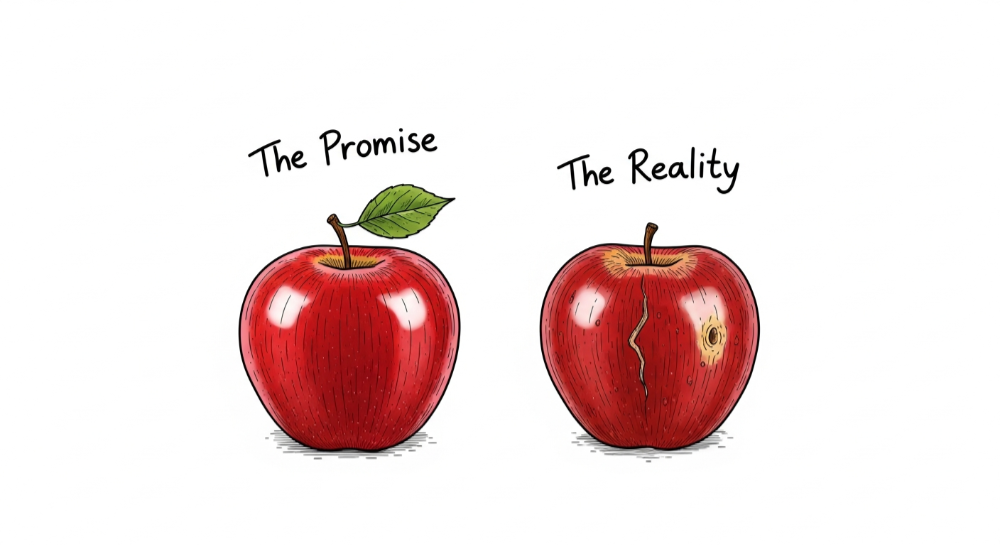
Steve Jobs lied to you
"The most powerful person in the world is the storyteller."
Steve Jobs said this.
LinkedIn regurgitates it daily.
And it's actively ruining your brand strategy.
I've spent seven years watching founders pour months into crafting the "perfect" brand story, hiring agencies, workshopping narratives, and perfecting their "why."
Then they launch into the VOID.
Because Jobs was only half-right.
The most powerful person isn't the storyteller; it's whoever controls what story gets told.
And that distinction is worth millions.
I'm a die-hard Jobs fan myself. If I get stuck on any business decision, I've always asked, "What would Steve do?"
But I wholeheartedly cannot agree on this one.
THE LIE BENEATH
Jobs didn't just tell Apple's story. He controlled every single touchpoint where it could be told.
- Product launches
- Retail environments
- Packaging
- Advertising channels
- The keynote stage itself
He wasn't the storyteller.
He was the studio executive.
Think about Hollywood for a second. The screenwriter writes the story. But the studio executive decides if that story ever sees the light of day. The algorithm engineer at YouTube has more power over which creators succeed than the creators themselves. The media mogul who owns the platform controls the journalist's reach.
A storyteller without distribution is just someone talking to themselves.
Jobs understood this. He built distribution infrastructure disguised as product launches. He created events that became their own distribution channels. He made the announcement of the announcement newsworthy.
Most founders?
They perfect their story, then pray the algorithm gods smile upon them.

Make Every Platform Work for Your Ads
You're running an ad.
The same ad. On different platforms. Getting totally different results.
That's not random: it's the platform effect.
So stop guessing what works. Understand the bit-sized science behind it.
Join Neuroscientist & Neurons CEO Dr. Thomas Ramsøy for a free on-demand session on how to optimize ads for different platforms.
Register & watch it whenever it fits you.
THE BRAND POWER HIERARCHY
After working with brands across revenue stages, from pre-launch to eight figures, I've noticed a pattern. There's a hierarchy of power in brand distribution. And most founders are stuck at the bottom without realizing it.
Level 1: Distribution Owners
These are the platforms. Meta. Google. LinkedIn. YouTube. Amazon's algorithm. They decide what millions of people see every single day. They write the rules. They change the rules. And they don't ask permission.
When Facebook's algorithm shifted in 2018, media companies lost 50%+ of their traffic overnight. That's Level 1 power.
Level 2: Gatekeepers
Editors who decide what gets published. Executives who greenlight projects. Curators who decide what gets featured. Podcast hosts who choose their guests.
They control access to Level 1's distribution. They're the bouncers at the club. And if you want in, you need their approval.
Level 3: Storytellers with Audience
Creators with earned distribution through trust. Brands with owned communities. Influencers with loyal followings.
They have power.
Real power.
But it's fragile.
One algorithm change can cut their reach in half. One platform shift can make their audience disappear.
They're one step above powerless, but they're still dependent on Levels 1 and 2.
Level 4: Storytellers without Audience
Everyone starting out. Brands with great stories and zero reach. The "undiscovered genius" waiting to be found.
Powerless until they climb to Level 3 or buy access to Levels 1-2.
But most founders think they're building Level 3 (audience). But they're actually stuck at Level 4 (obscurity) while renting access to Level 1 (paying Meta and Google for ads, this includes me as well).
They're not building anything. They're paying rent.
And rent goes up.
Look at the brands you admire.
Nike sits at Level 3 with massive Level 2 influence, they ARE the gatekeeper in athletic culture.
Your favorite DTC brand? Level 4, spending 40% of revenue renting Level 1 through Meta ads.
Tesla? Musk was at Level 3, then bought Level 1 when he acquired Twitter.
He stopped renting. He bought the DAMN building.
THE THREE PATHS OUT OF DISTRIBUTION HELL
So you understand the hierarchy.
You're probably at Level 4, renting access to Level 1, hoping to build Level 3.
What do you actually do?
There are three paths. Two of them are traps.
Path 1: Build Your Own Distribution
This means assets you control. Email list. Community you own. Platform you build. Media property with your name on it.
Morning Brew built email distribution, then sold for $75 million. Glossier built community before products. Stratechery built a subscription audience of enterprise buyers willing to pay $120/year for analysis.
They can't be taken away.
YOU OWN IT.
A little reality check is that it takes 2-5 years and requires consistent output. But most founders quit before reaching escape velocity.
The trap: Thinking "building an audience" equals posting on social media.
It doesn't.
Posting on LinkedIn is renting. Your followers are LinkedIn's users. The algorithm decides if they see you.
You own nothing.
Building an email list of 10,000 people who actually open your emails? That's ownership. That's Path 1. (I'm lucky I have over 19k)
Path 2: Rent Distribution Strategically
This means
- Paid ads
- Influencer partnerships
- Platform algorithms
- PR & media placement.
Every DTC brand you know uses this. SaaS companies with venture funding use this. Anyone running Facebook ads uses this.
It's fast, predictable (until it isn't) and scalable if the economics work.
The downside: Costs rise over time. Platform changes kill businesses overnight. Stop paying and you disappear immediately.
I've watched brands with $2M/month in Meta ad spend panic when CPMs jumped 40% in Q4.
THis is exactly what happens when you confuse "growth" with "building a brand."
When you're running ads, you're not building anything. You're renting shelf space. The moment you stop paying, you don't exist.
Path 3: Become the Story Others Can't Ignore
This is the highest leverage path and the hardest to execute.
It means creating something so compelling that distribution comes to YOU.
They are
- Movements, not messages.
- Controversy that forces conversation.
- Novelty that demands attention.
- Utility so high it creates organic sharing.
Liquid Death made water controversial. Duolingo became a meme. Oatly created a culture war over oat milk. Teslamade electric cars aspirational instead of environmental.
When this happens, distribution becomes free. Platforms feature you, and media covers you. Customers evangelize without being asked.
But their behavior can't be templated. It requires genuine insight into culture with a high risk of failure.
The trap: Thinking "going viral" is a strategy.
It's not.
It's an outcome of strategic positioning.
You can't plan virality. You can only create conditions where it becomes possible.
THE REALITY MOST FOUNDERS IGNORE
Most successful brands use all three paths simultaneously.
Path 1 for stability (owned audience). Path 2 for scale (paid acquisition). Path 3 for efficiency (earned distribution).
Which one are you building FIRST?
Because starting with Path 2 (renting distribution) without Path 1 (owned distribution) is building a house on rented land.
The landlord can raise rent. The landlord can evict you. The landlord can change the rules.
And you'll have nothing to show for it except a really good brand story that nobody hears anymore.
THREE QUESTIONS THAT MATTER MORE THAN YOUR STORY
Your brand story is probably fine.
Maybe even great.
But it doesn't matter until you can answer these three questions.
Question 1: Who controls whether anyone hears it?
Bad answers: "We'll post on social media." "We'll do content marketing." "We'll build a community." "Our story is so good it'll spread organically."
Good answers: "We're spending $50K/month on Meta ads with a 3x ROAS." "We have 10,000 email subscribers who open at 40%." "We have partnerships with five influencers who reach 2M combined." "Our product has a viral coefficient of 1.4."
See the difference?
Good answers have numbers, systems, and control.
If you stopped creating content today, would anyone still hear your brand story in six months?
If yes, you have distribution.
If no, you have a content treadmill.
Question 2: What makes someone share this?
Your brand story needs to do work beyond "communicating who you are." It needs to make people want to spread it.
What doesn't make people share: "We're authentic." "We care about quality." "We're customer-focused." "We're different." (While looking identical to everyone else.)
What makes people share:
- Identity signaling - "This says something about who I am." (Patagonia, Tesla)
- Social currency - "This makes me look smart or informed." (Liquid Death, Oatly)
- Utility - "This solves a problem my friend has."
- Emotion - "I need others to feel what I felt."
- Novelty - "No one has seen this before."
When someone encounters your brand, what do they GET from telling someone else about it?
If the answer is "nothing," your story won't spread no matter how good it is.
Question 3: What position are you actually fighting for?
Most founders confuse "brand story" with "brand strategy."
Your story is WHAT you say. Your strategy is WHICH position you're claiming in the market.
Telling a beautiful story while fighting for a position you can't win.
Unwinnable positions:
- "High quality, affordable, sustainable fashion." (You're describing 10,000 brands.)
- "We help businesses grow." (Consultant-speak for "we're undifferentiated.")
- "The Airbnb of X." (You're literally saying you're not original.)
Winnable positions:
- Starling Bank owned "the boring bank."
- Ugly Drinks owned "no added nonsense."
- Liquid Death owned "water for people who hate wellness culture."
Complete this sentence: "We're the only _____ that _____." If you can't fill that in with something defensible and ownable, your brand story is noise in a crowded market.
THE GATEKEEPER MOVE
Even at Level 3, as a storyteller with an audience, you're vulnerable. Algorithms change, and your reach dies. Platforms shift, and your distribution evaporates. You stop creating, and you stop existing. Competitors copy, and you lose differentiation.
You're on a content treadmill. The moment you stop running, you disappear.
Gatekeepers don't have this problem.
Gatekeepers don't create dependency on their content. They create dependency on their INFRASTRUCTURE.
Level 2 power means other people need to go THROUGH you to reach their goals. You control access to something valuable. Your position exists independent of your daily output.
There are four gatekeeper positions you can build:
Credentialing: Create certification that the market recognizes. StoryBrand certification for agencies. HubSpot certification for marketers. Employers filter for your credentials. Practitioners must go through you to get validated. You control the standard.
Marketplace: Build a platform that connects buyers and sellers. Upwork for freelancers. Behance for designers. Clients come to your platform first. You control deal flow.
Methodology Licensing: Make your framework the industry standard. EOS for business management. Jobs-to-be-Done for product strategy. Agencies license your methodology. Consultants get trained in your framework. Can't operate at scale without your system.
Editorial Platform: Turn your brand into a multi-contributor media property. First Round Review. Stratechery. HBR. Best thinkers pitch YOU to get featured. Your platform becomes THE place to get discovered. You control whose ideas get amplified.
THE ASYMMETRY THAT CHANGES EVERYTHING
Storyteller math: Stop creating = stop earning.
Linear relationship between effort and outcome and can be easily replaced by the next storyteller.
But infrastructure earns independently of daily output. Network effects compound over time, which makes it nearly impossible to replace once established.
That's why an AI coding tool can build the next LinkedIn or Gumroad in seconds but can never replicate the network effect these platforms have.
So sre you building a storytelling business that depends on your continued output? Or are you building infrastructure that controls which stories get told in your market?
Because a mediocre story with great distribution beats a great story with no distribution.
Every.
Single.
Time.
Pick one gatekeeper position. Build it quietly while you storytell publicly.
In three years, you'll own a position no one can take from you.
That's when you stop being a storyteller.
And become the person who decides which stories get told.
Your fractional CBO,
Shashank
P.S.
If you're still explaining what you do to prospects, you've already lost.
Clear brands don't explain. They own a category in the customer's mind.
Unclear brands spend every sales call trying to differentiate themselves. Then they lose to competitors who charge 2.5x more with worse products.
I built a free 5-day email course called The Brand Diagnosis that shows you what's actually broken. Takes 10 minutes per day. By Day 5, you'll know whether it's positioning, messaging, or differentiation and how to fix it.
▶▶ Sign up and get Day 1 tomorrow.
11, PNR Nagar
Dindigul, Tamil Nadu 624001, India

No comments yet. Be the first to comment!