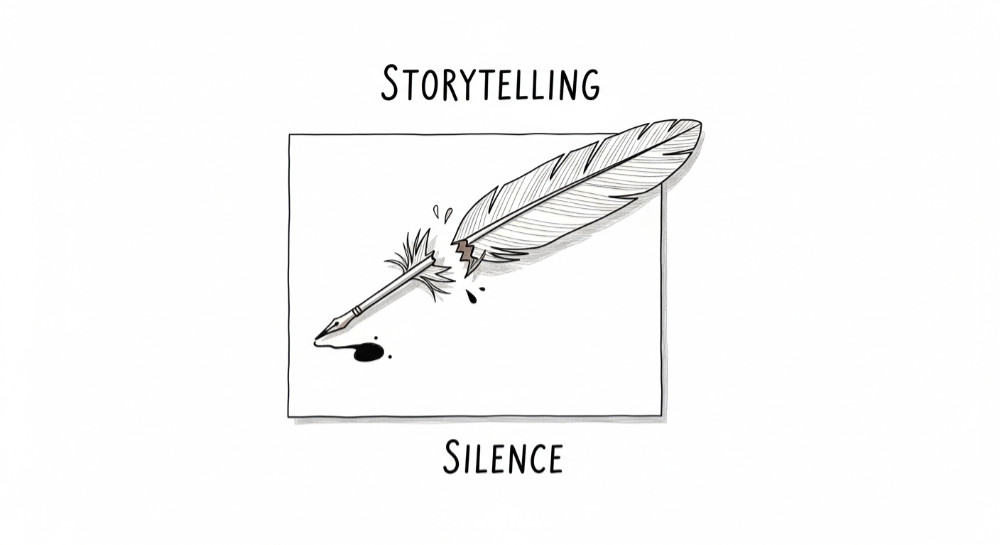
The death of storytelling
"Seven things that make Apple's branding GENIUS, and number four will blow your mind."
You've seen this thumbnail. You've clicked it. You felt cheated twelve minutes later when "number four" turned out to be "they focus on simplicity."
This is what passes for storytelling now.
Companies are hiring "storytellers" at $274,000 a year. LinkedIn job postings with the word "storyteller" doubled in the past year. Executives said "storytelling" on earnings calls 469 times this year, up from 147 times in 2015.
Everyone wants storytellers. Nobody knows what storytelling means.
We've confused hooks with stories. We've mistaken tension-bait for tension. We've turned narrative, the oldest human technology for transferring emotion into a cheap trick for harvesting clicks.
The YouTube formula is seductive. Open with a promise so outrageous the viewer can't scroll past. Tease a revelation that never comes. Pad the middle with filler. End with a subscribe button.
If you roll back this all started with the clickbaity lifestyle blogs that were just making money on ads.
I'm not against one platform. But this is a slot machine dressed in a narrative costume.
Real storytelling looks nothing like this.
Consider the moment Darth Vader first confronts Obi-Wan Kenobi after becoming more machine than man. The anger. The vulnerability. The desperate need to prove he made the right choice by destroying everything he loved.
You feel all of it.
And here's the thing, you can't see the actor's face. Vader wears a helmet. No eyebrows to furrow. No tears to well up. No micro-expressions to read.
The emotion comes from somewhere else entirely.
It comes from the cadence of his breathing. The controlled menace in his voice. The way his body moves, mechanical yet somehow betraying the broken human underneath. And underneath it all, John Williams' score tells you exactly what Vader cannot say.
That's craft.
That's decades of filmmakers understanding how humans process emotion and engineering every frame to trigger it.
No "wait for it." No "you won't believe what happens next."
The modern internet has strip-mined storytelling for parts. Content creators discovered that certain narrative structures trigger dopamine responses. The open loop. The curiosity gap. The promise of transformation. These are legitimate storytelling tools and screenwriters have used them for a century.
But there's a difference between using tension to serve a story and using the appearance of story to manufacture engagement.
The first approach respects the audience. It says that I have something meaningful to share, and I'll use craft to help you receive it.
The second approach exploits the audience. It says that I know which buttons to push in your brain, and I'll push them to extract your attention.
One builds trust.
The other burns it.
You can feel the difference, even if you can't articulate it.
When someone opens with "I was $50,000 in debt, sleeping in my car, about to give up forever, then I discovered this ONE trick" your brain lights up.
Three minutes later, you realize the "trick" is posting consistently on LinkedIn. The debt was student loans. The car was where they napped between meetings.
You've been had.
The storyteller used narrative scaffolding without narrative substance. They built a beautiful frame around an empty room.
Companies are now building entire teams around "storytelling." USAA has four staff storytellers. Google has a "Cloud storytelling team." Microsoft is hiring a "senior director overseeing narrative and storytelling."
The word appears in 50,000 marketing job listings and 20,000 communications roles.
When everyone claims to be a storyteller, the word means nothing. And when companies hire "storytellers" who learned the craft from YouTube thumbnails instead of actual narratives, they get content that feels like content.
The irony is brutal, in an age where AI can generate infinite content slop, authentic storytelling --- the kind that makes you feel something real is the only competitive advantage left.
And we're teaching an entire generation that storytelling means "hook harder."
Real storytellers understand something the content mills don't.
A story isn't a trick to capture attention. It's a vehicle for transferring emotional truth from one human to another.
Darth Vader's confrontation with Obi-Wan works because George Lucas spent three films building the relationship. Because the audience knows what Anakin sacrificed to become Vader. Because every element, the dialogue, the pacing, the music, the silence serves the emotional truth of that moment.
You can't replicate that with a clickbait template.
Let the hook emerge from the story, not the other way around.
The filmmakers who made you cry during a Pixar movie didn't start with "what thumbnail will get clicks?" They started with "what human experience are we illuminating?"
That's the difference between storytelling and story-shaped content.
One changes how people see the world. The other changes your impression count for the next 48 hours.
Companies hiring "storytellers" at six figures should ask one question in every interview: "Tell me about a time you made someone feel something they weren't expecting to feel."
If the candidate talks about open loops and curiosity gaps and optimized hooks, they're a content technician.
If they talk about a moment when craft and truth combined to create something that stayed with the audience long after they stopped watching, that's a storyteller.
The internet has enough technicians.
It's desperate for people who understand that storytelling is the oldest human technology for transferring what it feels like to be alive and that no amount of hook optimization can replicate what happens when that technology is used with skill and intention.
The seven-point listicle won't save your brand.
But one true story might.
Based on: https://www.wsj.com/articles/companies-are-desperately-seeking-storytellers-7b79f54e
11, PNR Nagar
Dindigul, Tamil Nadu 624001, India

No comments yet. Be the first to comment!