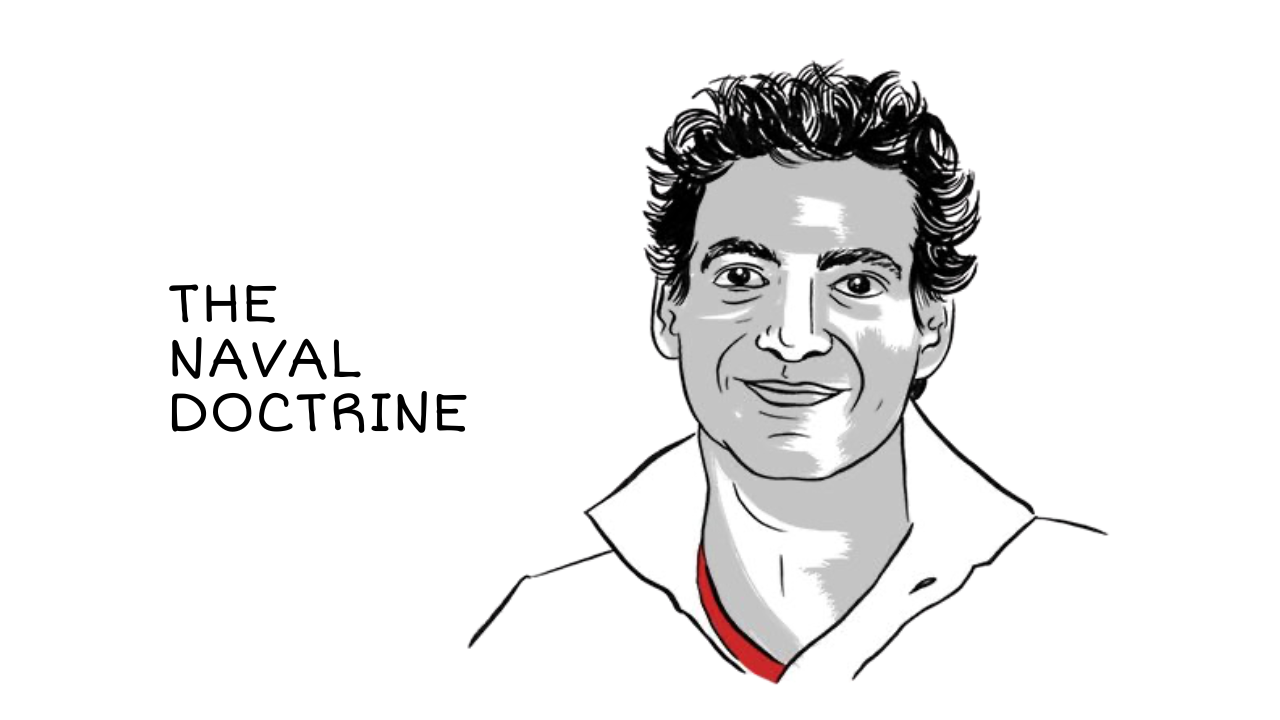
The Naval Doctrine

There's a man who built a billion-dollar company, created a platform that changed how startups get funded, and somehow became more famous for his tweets than his exits.
Naval Ravikant doesn't fit into a box. He's a tech investor who reads philosophy for breakfast. A startup founder who quotes Buddha in board meetings. A capitalist who talks about happiness like a monk.
And that's exactly why you can't look away.
His approach to brand-building isn't in any marketing textbook. It doesn't involve personas or positioning statements or carefully crafted brand guidelines. What he's built and what he teaches is something far more radical:
The most powerful brand you can build is one that cannot be replicated. Because it is you.
Here are ten principles from Naval's philosophy that will change how you think about building a brand.

PRINCIPLE 1: THE BEAR ON A UNICYCLE
"If you go to a circus and you see a bear, that's kind of interesting but not that much. If you see a unicycle, that's interesting. But you see a bear on a unicycle, that's really interesting."
Naval uses this metaphor to explain his own unlikely appeal. He combines things you're not supposed to combine: hard-nosed investing with Eastern philosophy. Startup hustle with inner peace. Wealth creation with wisdom literature.
The most memorable brands aren't the ones that fit neatly into a category. They're the ones that create a new category by combining things nobody thought to combine.
Think about it: What two worlds do you live in that most people keep separate?
Maybe you're an accountant who also does improv comedy. A software engineer who's obsessed with Renaissance art. A corporate lawyer who grows mushrooms on the weekend.
The combination is the brand. The weirder the intersection, the more interesting you become.
Diagnostic question: What are two things you're genuinely obsessed with that seem like they don't belong together? That's your bear on a unicycle.
Know what works before you spend.

Discover what drives conversions for your competitors with Gethookd. Access 38M+ proven Facebook ads and use AI to create high-performing campaigns in minutes --- not days.
PRINCIPLE 2: SPECIFIC KNOWLEDGE CANNOT BE TRAINED
Naval makes a crucial distinction: there's generic knowledge (anyone can learn it) and there's specific knowledge (it can only be developed through lived experience).
Generic knowledge creates competition. Specific knowledge creates monopoly.
"If society can train you, it can train someone else and replace you."
But specific knowledge? It's the stuff you picked up because you couldn't help yourself. The rabbit holes you went down when nobody was watching. The skills you developed because you were obsessed, not because it was on a syllabus.
Here's the framework:
THE SPECIFIC KNOWLEDGE HIERARCHY:
- Level 1: Trained skills (replaceable, low value)
- Level 2: Experience-based skills (harder to copy, medium value)
- Level 3: Obsession-based knowledge (nearly impossible to copy, high value)
- Level 4: Identity-fused knowledge (truly irreplaceable, maximum value)
Level 4 is where the magic happens. It's when your knowledge becomes so fused with who you are that separating the two is impossible.
Naval's specific knowledge isn't "investing." It's the specific intersection of tech evaluation, philosophical frameworks, and first-principles thinking that he's been building since he was 13 years old.
Diagnostic question: What do you know that you've never been formally trained in, but you've been learning your entire life?
PRINCIPLE 3: ACCOUNTABILITY IS THE UNLOCK
The people who build the biggest brands are the ones willing to put their name on the line.
"The most powerful money makers are actually individual brands, people like Elon or Kanye or Oprah or Trump. These are individual brands, eponymous name brands who themselves are leveraged."
Naval isn't hiding behind a corporate veneer. He's not "the founder of AngelList." He's Naval. The brand and the person are one.
This is terrifying for most people. If you fail publicly, it's your failure. If you say something wrong, your name is attached to it. If things go sideways, you can't disappear into the corporate machine.
But here's what accountability unlocks: trust at scale.
When you put your name on something, people know you have skin in the game. They know you're not going to disappear. They know that your reputation is tied to delivery.
The formula: Accountability + Skin in Game + Public Name = Trust Multiplier
Anonymous operators don't build brands. People who hide behind corporate masks don't build followings. The willingness to be personally accountable is the price of admission.
PRINCIPLE 4: AUTHENTICITY IS YOUR MOAT
Naval says something that sounds almost too simple to be true: "No one can compete with you if you love to do it."
Read that again.
If you're doing something because you think you should, you're vulnerable. Someone who actually loves it will outwork you every time.
"If they want to compete with me and they're going to work, they're going to lose. Because they're not going to do it 16 hours a day, 7 days a week."
This flips the entire competitive landscape.
Most people ask: "What should I do to get ahead?"
Naval asks: "What would I do for 16 hours a day without getting tired?"
Because that thing --- the thing you'd do even if nobody paid you, is your unfair advantage. It's where authenticity becomes a moat.
The imitators will burn out. The grinders will fade. But you'll still be here, doing what you love, getting better every day.
Diagnostic question: What could you do for 16 hours a day, 7 days a week, and still call it play?
PRINCIPLE 5: LEVERAGE CREATES REACH
Here's where Naval gets practical. Having a unique voice means nothing if nobody can hear it.
"We live in an age of infinite leverage. Your actions can be multiplied a thousand fold, either by broadcasting on a podcast, or by investing capital, or by having people work for you, or by writing code."
THE LEVERAGE HIERARCHY:
- Labor (people working for you) --- Limited, requires management
- Capital (money working for you) --- Requires money to start
- Code (software working for you) --- Scalable, requires technical skill
- Media (content working for you) --- Most accessible, scales infinitely
Naval built his personal brand primarily through Level 4: Media.
His tweets, his podcast, his appearances on other shows, all of it is content that works while he sleeps.
The magic of media leverage: every tweet is a seed. Every podcast episode is an asset. Every piece of content is working for your brand 24/7, multiplying your reach without multiplying your effort.
The modern brand equation: Specific Knowledge + Accountability + Media Leverage = Exponential Reach
You don't need a massive team. You don't need venture capital. You need a microphone, a keyboard, and ideas worth sharing.
PRINCIPLE 6: THE LONG GAME IS THE ONLY GAME
Naval explicitly rejects short-term thinking:
"Build wealth in a very long-term kind of way. Not the banker crash-the-economy, bail-out kind of way. But build businesses and help people and provide value kind of way."
Most people are playing checkers. Naval is playing a multi-decade game of chess.
He doesn't optimize for this quarter's numbers. He builds relationships that compound over years. He creates content that becomes more valuable over time, not less. He invests in his reputation the way others invest in stocks, patiently, consistently, with an eye toward decades, not quarters.
The Long Game Framework:
- Short-term players optimize for attention → Their brand is noise
- Medium-term players optimize for transactions → Their brand is transactional
- Long-term players optimize for trust → Their brand is durable
The compounding effect is real. Every truthful thing Naval has said adds to his credibility. Every accurate prediction builds his track record. Every valuable insight compounds his reputation.
Short-term games attract short-term people. Long-term games attract the people you actually want.
PRINCIPLE 7: SPECIALIZATION IS FOR INSECTS
Naval quotes Robert Heinlein: "Specialization is for insects."
And he means it. His interests span tech investing, philosophy, happiness research, fitness, meditation, wealth creation, and a dozen other domains.
This is a direct challenge to the "niche down" advice you've heard a thousand times.
"Every human basically is capable of every experience and every thought. I like the model of life that the Ancients had, the Greeks, the Romans, where you would start out young, then you're going to war, then you're running a business, then you're supposed to serve in the senate, then you become a philosopher."
The brand you're building isn't a narrow slice. It's a whole person with multiple dimensions.
The Polymath Brand Advantage:
- Unique combinations (bear on unicycle)
- Cross-domain insights (pattern recognition)
- Resistance to obsolescence (multiple skills)
- Human relatability (people are multidimensional too)
The specialist is replaceable. The polymath who can synthesize across domains? That's rare. That's valuable. That's a brand.
PRINCIPLE 8: POSITIVE-SUM GAMES ONLY
Naval draws a hard line between two types of games:
Zero-sum games: Your gain is my loss. Status games. Political games. Win-lose dynamics.
Positive-sum games: Your gain is also my gain. Wealth creation. Value building. Win-win dynamics.
"You should all be for playing positive-sum ethical games."
Zero-sum players eventually run out of people to extract from. Their reputation becomes toxic. Their network atrophies. They win battles but lose the war.
Positive-sum players attract other positive-sum players. Their network grows. Their reputation compounds. They become known as people who create value rather than capture it.
The Brand Litmus Test:
- When you win, do others also win?
- Are you creating value or just redistributing it?
- Would the people you work with recommend you?
Naval's brand isn't built on defeating competitors. It's built on helping founders succeed. That generosity of spirit is felt by everyone who encounters him.
PRINCIPLE 9: THE BEGINNER'S MIND
Naval admires Elon Musk for something most people overlook: his willingness to look stupid.
"The greatest artists and creators have this ability to start over that nobody else does. Elon will be called an idiot and start over with something brand-new that he's supposedly not qualified for."
Most people who build an initial success get trapped by it. They're afraid to start over because starting over means being a beginner again.
But beginners are free. Beginners ask the questions experts have forgotten. Beginners see solutions that experience has blinded others to.
The Beginner's Mind Paradox: The more you're willing to look foolish, the faster you can learn. The faster you learn, the more formidable you become.
Madonna. Paul Simon. Elon Musk. These aren't people who peaked and plateaued. They're people who abandoned the peak to find another mountain.
Diagnostic question: What are you avoiding learning because you're afraid to be a beginner again?
PRINCIPLE 10: PEACE IS THE ULTIMATE LEVERAGE
This might be Naval's most counterintuitive insight.
"A happy, calm, peaceful person will make better decisions and have better outcomes. So if you want to operate at peak performance, you have to learn how to tame your mind just like you have to learn how to tame your body."
Most entrepreneurs think stress is the price of success. Naval disagrees. He thinks stress is a tax on success.
"Warren Buffett plays bridge all day long and goes for walks outside. He doesn't sit around constantly loading his brain with non-stop information and getting worked up about every little thing."
The Peace-Performance Framework:
- Cluttered mind → Poor judgment → Worse outcomes
- Clear mind → Better judgment → Better outcomes
- Better outcomes → More success → More resources
The stressed-out founder making reactive decisions is losing to the calm founder making deliberate ones.
This is Naval's ultimate brand insight: the internal state creates the external result.
Your brand isn't just what you say. It's the energy you bring. It's whether people feel calm or chaotic around you. It's whether your presence creates clarity or confusion.
Naval's calm confidence is part of his brand. It's not separate from his investing success, it's a precondition of it.
THE META-PRINCIPLE: YOUR BRAND IS YOUR LIFE'S WORK
When you step back from these ten principles, a larger pattern emerges.
Naval isn't building a brand. He's becoming someone. He's doing the internal work. He's developing unique knowledge. He's playing the long game. He's staying peaceful while others burn out.
The brand is a side effect.
You can't shortcut authenticity. You can't fake specific knowledge. You can't pretend to be playing the long game while secretly optimizing for this quarter.
The best brands are built by people who would be interesting even if nobody was watching. People who are doing the work because the work matters to them.
Naval's brand works because Naval is genuinely trying to figure things out about wealth, about happiness, about life. The brand is just the broadcast of that genuine quest.
Your final diagnostic question.
If you knew nobody would ever see your work, would you still do it?
Because that stuff you'd do anyway is where your brand begins.
Everything else is just marketing.
And marketing fades. Authenticity compounds.
That's the Naval doctrine.
Now go find your bear. Find your unicycle. And get to work combining them.
--- Shashank
11, PNR Nagar
Dindigul, Tamil Nadu 624001, India

No comments yet. Be the first to comment!