The scroll test
So many newsletters are a slow-motion car crash. They start with high hopes, hit a wall by issue 7, and die before issue 10.
Francis Zierer is about to ship his 150th issue and hasn't missed a single one."
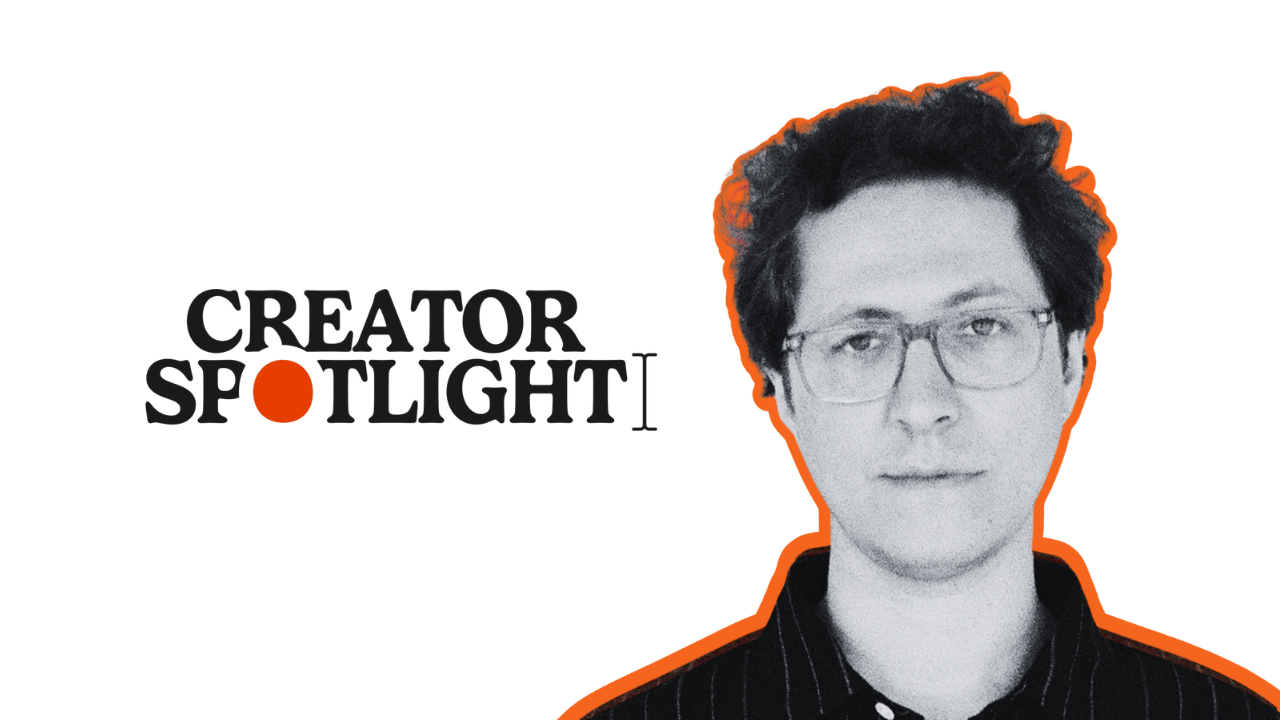
He runs Creator Spotlight, beehiiv's in-house publication with 400,000+ subscribers. But here's the "positioning" everyone missed. His job isn't to sell beehiiv software. It's to build a brand people actually give a shit about reading.
That distinction --- the gap between "marketing collateral" and "editorial authority", is why beehiiv is winning the category.
I sat down with Francis to deconstruct the "Brick by Brick" manual on how he scaled Creator Spotlight from a side project to a standalone industry power.
Q: How did the internal conversation at beehiiv start regarding the need for a dedicated publication like Creator Spotlight, and what was the "North Star" goal for the brand initially?
The "North Star" was to create a high-quality, well-respected, and widely-read publication covering the creator economy --- entirely owned and operated by beehiiv. Candidly, during the interview process, beehiiv CEO Tyler Denk described it to me like this: "We want to accomplish what HubSpot did in acquiring The Hustle, but in-house from the start."
The first beehiiv creator spotlight was published on March 2, 2022, nearly two years before I joined the company.
Nearly every platform that has creator-users has produced some type of creator spotlight. TikTok has a creator spotlight page, YouTube does. It's a type of case study focused on individual users rather than companies.
That classic creator spotlight format --- and beehiiv's original creator spotlight series --- aims to elevate users, leverage their audiences for distribution, and educate existing and potential users on the accomplishments the platform enables.
Creator Spotlight started in that platform-specific style and grew to around 175k subscribers over the course of 22 months and 71 issues before I took over.
The newsletter had a few different writers during that initial period, and while they produced good work, it was always a side project. Responsibility was shared between a few people based on availability.
Tyler pushed to hire a dedicated editor to own the project. As he first put it to me, with an engaged audience already in place, the project just needed an intrapreneur who could establish and execute against an ambitious vision.
Q: In the "Brick by Brick" spirit, what were the first few foundational elements (the first bricks) you put in place to differentiate Creator Spotlight from other "creator economy" news sources?
The first was to abandon the restriction of only writing about beehiiv users.
This would elevate Creator Spotlight from the platform-specific creator spotlight genre and place us in the broader creator economy resource landscape. More to the point, it would allow us to center creators and their work over beehiiv; to serve creators first and foremost; to expand our total addressable audience.
It would've been redundant and a waste of resources if I only covered beehiiv users; beehiiv already had an exceptional case study program (see this recent example on former "Washington Post TikTok guy" Dave Jorgenson's new company, Local News International).
The second was to focus on a profile format over tactics or news.
There were already high-quality newsletters focused on tactics and news for creators. Most had years of industry specialization and full teams behind them; without those years of industry experience and connections, I knew I wouldn't be able to compete on my own.
There were other products focused on creator profiles, but I know I could compete with them. This was my element, the game I could win. Those were the stories I was driven to tell: how they honed their production, audience development, and business skills; how they identified their place in the broader media landscape; their failures and flaws.
I wanted to produce human-interest journalism, based on the belief I still hold that there is a larger and more sustainable audience for empathetic, anthropological coverage of the people working in the creator economy than for hardcore tactical writeups.
We still interview plenty of beehiiv users and we always aim to provide a tactical education element, but the focus in the profiles specifically is always on the person first, not the platforms they use, not their tactics. Tactical education needs a story to sugar the pill.
Q: Creator Spotlight has a very distinct, polished editorial voice. How did you define this brand persona, and how do you ensure it stays consistent across different writers and interviewers?
At the beginning, for myself and the beehiiv team, I articulated the voice I was after in a couple of documents. After that, as I worked alone, it was all in my head; it was easy to stay consistent when I was the one doing all the work. There was nobody to articulate it to (except our podcast producer and graphic designer, for their parts).
The goal was to produce quality journalism that wouldn't feel out of place in a traditional publication as opposed to commodity lead-gen content that fills the pages of so many corporate blogs.
For interviews, reference points included those published in The Paris Review and The Creative Independent, two outlets I'd loved for years. For profiles, I looked to writers like Jonah Weiner in the Times and many writers producing profiles for The New Yorker . I read a lot of Eli Saslow's work for the Times during my prep.
That's the bar I set. Reaching it every week was impossible, of course.
I always knew I'd be working with a few limitations. When I started, for at least the first year, I would be working alone (save for beehiiv's in-house designer to execute graphics and, eventually, our podcast editor).
With no editor besides myself, I had to publish one interview every week; I'd only be able to put so much time into each edition. I started using Claude as an editor, especially to help me find redundancies in my writing and axe down the word count.
When we brought in another writer full-time last spring, Natalia Pérez-González, I put together a style guide to get her up to speed on the voice and style, but I still edit every edition before we send it out (and she edits my writing). We had around 800 applicants for that Assistant Editor role, and only considered applicants with writing samples; part of why we chose her was because her style was already aligned with the Creator Spotlight style.
For the interviews, though Natalia has joined as co-host a few times, I'm still doing every one (at least, every one we publish on the podcast feed).
Q: Your deep dives often feel more like investigative journalism than standard PR interviews. How do you approach "brand trust" so that high-level creators feel comfortable sharing their specific metrics and tactics?
The audience has to come first --- we aim to deliver entertainment and education in every edition. They wouldn't show up if we just published PR interviews every week. Nor, frankly, would I! If Creator Spotlight is a high-quality product, it's because I'm given creative freedom to make it so. Tyler and team have put that belief in me from the beginning.
I have to be able to ask questions about specific audience or revenue numbers, about flaws and failures. That said, I'm not confrontational with our guests. This is not gotcha journalism; I'm not Isaac Chotiner and this is not The New Yorker .
Anybody we feature should be proud to have participated, to share the interview willingly. That's the catch --- as an interview-based product, we need people to want to sit for an interview.
Guest curation is the most load-bearing part of the job. We are promoting any given interviewee, so I focus, for the most part, on creators with aspirational stories. I spend plenty of time pre-researching potential guests to the point where I can envision the shape and outcome of the interview, to identify people amenable to our desired output.
I have three basic filters for this:
- The audience demands entertainment and education. Does this person have something unique or otherwise compelling to offer on the topics of media production, audience development, or business development?
- Every edition includes an audio-video podcast. Can I trust this person to speak articulately about their work, to be generous and transparent with the details, and to be a willing and engaged conversational partner over a 1--2 hour recording?
- Am I personally compelled by their work and character? Does it feel appropriate to dedicate dozens of hours of my and my team's time to an interview and all related outputs?
There's more to it, plenty of caveats; these are the most basic requirements.
I very rarely book an interview until I've had the chance to meet the person, even just for 15 minutes, to make sure they understand our intentions and our audience. I make it clear that this is not a standard PR interview, that any PR outcome they desire will be increased by the type of questions we ask.
Q: How has the brand identity of Creator Spotlight evolved as the newsletter grew from a "feature" of the platform to a standalone authority in the industry?
Before I took over, the branding was totally aligned with beehiiv's branding. Same purple tones, same fonts. Again, the idea was to cover creators broadly rather than just beehiiv users, so it made no sense to keep that identity.
We completely overhauled the brand on publication of my first issue. Over the month preceding, I worked with beehiiv's in-house designer Laura Calle Puerta, on the details.
Lots of logos in the scrap pile. The one we landed on has a blinking I-beam cursor and a red dot as references to two of the tools creators use most --- word processors and cameras.
The tonal beiges are a nod to publications like the Financial Times and Semafor --- colors we associate with publications serving professional audiences.
The editorial voice, the brand identity --- these decisions were made to elevate what is, for many people, still a frivolous topic. To communicate that we take creators seriously; to communicate creators as a serious topic.
The beehiiv branding is loud and specific, built for a software product people pay to use. We're building a free editorial product. They serve different but overlapping audiences and we did not want Creator Spotlight to be subsumed by the beehiiv brand.
We want our work to be useful to beehiiv users, yes, but equally important is anyone working in or interested in the creator economy.
Q: What is the specific role of visual branding, the layout, typography, and custom imagery in making the Creator Spotlight brand feel premium and "must-read"? Because Creator Spotlight is one of the very few newsletters that quickly pops out when someone takes a look at it, and as a very long-time reader, I feel like it immediately grabs my attention and is very aesthetically pleasing.
The word is texture.
I've already detailed some of the brand decisions in previous answers, but the function of the different sections, the custom-image headers and line breaks --- all of the visual details you listed in the question --- is to create texture.
The newsletter can get quite long --- typically between 1,300 and 2,000 words, including everything from the intro letter to ads the main article. The visual details serve to make the information digestible.
Every issue has to pass the scroll test --- If I open this up and quickly scroll through the whole thing, as plenty readers do (I do this with plenty of newsletters), does anything pop out of the blur and catch my eye, draw me in, get me reading?
A newsletter is a visual product.
My interview with Ernie Smith, creator of the Tedium newsletter, influenced how I think about this. He started his career in newspaper design, and his newsletter is not the most visually complex, but it is visually distinct and deploys relatively straightforward font size, color, and number decisions to elegant effect.
Creator Spotlight has a more involved design than most newsletters --- color-background sections, custom graphic headers. But a well-designed newsletter isn't necessarily about these details, it's about the scroll test , which the detailing serves.
Every time we write an issue, we send ourselves a test email and scroll through it, first on our phones and then on our computers. Scroll rapidly. Does anything catch the eye, or does it all blur together?
Most newsletter readers lose loyalty over time (I know my taste for any given newsletter ebbs and flows). Every issue we send, there will be people who open it and barely read, just skimming. The scroll test is about capturing their attention, drawing them in.
Q: How do you balance the Creator Spotlight brand as its own entity versus it being a marketing arm for the beehiiv product?
Simple: my mandate is not to market the beehiiv product, it's to create a high-quality editorial product.
Creator Spotlight is a marketing arm for the beehiiv product in that we use beehiiv to produce a high-quality editorial product; it's a case study itself.
We do keep track of how many beehiiv users enter the ecosystem through Creator Spotlight before eventually becoming paying customers of the product ... but the most important way we market beehiiv through Creator Spotlight is in the type of guest we select and the questions we ask them.
We feature creators who might use competing email service providers or might not have a newsletter at all, maybe their focus is YouTube, but the common thread is that they approach their work seriously as a business .
The most popular creator platforms, the ones that shape the mass definition of "creator," are free to use or take-rate and thus don't require their users to justify an up-front cost. beehiiv has a free offering but is really a pay-to-use tool for customers across the spectrum from prosumer to enterprise.
I seek out people on that spectrum for our interviews. I ask them questions about their business that our audience might learn from; we want our readers to become fluent in the business of being a creator.
In this way, we are propagating a type of "creator" aligned with the beehiiv customer profile; we are encouraging creators to treat their businesses seriously, out of the belief that creators serious about their businesses will benefit from using the beehiiv product over any competing products.
Q: How do you measure "brand equity" for the newsletter? Is it just open rates and subscribers, or are there deeper qualitative signals you look for?
That you reached out to do this interview is one signal!
We have a spreadsheet where I record 42 different metrics 72 hours after we send every edition of the newsletter. But the majority are temperature readings for posterity, to identify patterns over time. I only surface 7 to the broader team each week.
The most important signals we monitor are:
- Monthly active readers (MAR). How many people have opened our emails in the last 31 days? We track 0 unique opens over this period, 1, 2, 4, 7. We send 8 issues in a typical 31-day period, so 4 measures how many people opened half, for example, and 7 means they opened all or close to it.
- Podcast listenership (across both RSS feeds and YouTube). We track listens in the first three days for each episode and across a weekly period for the entire catalog.
- Industry acknowledgement --- requests for interviews like this one, or to speak on panels, aggregation of our writing in other industry newsletters, references to our work on social media, etc.
- Ad revenue. We offer sponsorship packages; our ability to attract the right partners and sell through is a quantifiable measure of brand equity.
Q: What was a significant "pivot" or structural change you made to the brand after seeing how readers responded to early editions?
Brevity.
Some of my earlier issues got up to 3,000 words. This one with Casey Lewis, two months into my tenure, might be the longest. Before the podcast, and into the early days of the podcast, we'd publish excerpts from the interview transcript.
Sections present in that issue that we don't have today include:
- The interview excerpt
- "Zoom out" --- a few distilled takeaways from the interview
- An outro letter with a feedback poll and a preview of the next week's issue
- A what-we're-reading links roundup
Rereading that issue for the first time in at least a year, I love the depth, but most subscribers just aren't going to have time for it. We've sought to streamline the product as much as possible --- brevity is a service we aim to provide our readers. The podcast exists for folks who want more from any given guest.
Q: How does the brand stay relevant in an oversaturated market of "newsletters about newsletters or creators", what is your unique value proposition?
It's a nonstop challenge. Like any newsletter, we lose subscribers with every send.
One of my mottos is: be consistent but not predictable. Consistent in quality, not predictable in the type of guests we curate and the questions we ask them.
We have to take risks with our guest selection. I know not every guest will resonate with every reader, our remit is too wide for that. So we have an appetite for risk there.
We're overdue to shake up the format again. Just like much has changed since that Casey Lewis issue two years ago, if the product doesn't have a few significant differences one year from now compared to today, we've played it too safe.
The unique value proposition, which we do not seek to change, is how we see creators. Creators before platforms, creators as an underserved and overexploited class of worker.Creator Spotlight is an ongoing research project with the goal of making the working creator's job easier.
Q: Can you walk us through the brand's distribution strategy? How do you ensure the Creator Spotlight brand reaches new audiences beyond the existing beehiiv database?
The beehiiv user base remains our important source of growth.
Second is paid growth. We spend thousands of dollars a month on Meta ads.
Third is word-of-mouth. Are we producing work good enough to earn a share? Are we including enough guests with sizable audiences and a willingness to share their interview?
Q: How much of the brand's success is tied to the personal brands of the editors and producers versus the institutional brand of beehiiv?
Our goal is for Creator Spotlight to be the primary brand here. I don't have a major social following --- my biggest is on LinkedIn, where I have 4,600 followers at the time of writing. Nor does Natalia have a major following, nor our podcast editor Tom McCloud, nor our designer Laura Calle Puerta. Tyler Denk, beehiiv's CEO, does have a large personal brand and he lends that weight to us sometimes, but that's separate.
The brand's success is tied entirely to the quality of the product. The guests we curate, the questions I ask them on the podcast, the articles we write. If the quality is there, subscribers stick around, people share our work, advertisers want to spend their budget with us.
The brand's success is certainly connected to my voice as editor, but not irrevocably bound to it.
As my personal brand grows, I'll use it to grow Creator Spotlight and vice versa, but I was not hired for my social following, I was hired for my editorial ability.
Q: What is the most underrated "brick" in building a newsletter brand that most creators ignore or overlook in the beginning?
The most practical thing you can do in building a newsletter brand is to create a simple, outcome-based welcome email. You may eventually need multiple versions as your audience grows, but if you're trying to build an audience in earnest, build a welcome email.
beehiiv has a thorough guide on 11 different types of welcome email.
For Creator Spotlight , we have two variants. One serves subscribers who come to us from beehiiv, the other serves subscribers who come from outside that ecosystem (paid ads, word of mouth).
We introduce the concept, share a few of our most popular pieces to give them an impression, and ask them to reply with a little bit of information about themselves (favorite creators, their own work as a creator). This helps deliverability (signals to Gmail or whichever email client they use that our email should land in the primary inbox) and helps us learn about our subscribers. We've found guests this way!
You might also ask them to fill out a survey in this email, but that can be done separately, as part of a signup flow (here's how to set one up using beehiiv). Set up a survey from the start --- doesn't have to be many questions, but if you plan to work with advertisers, for example, this is where you collect the demographic, income, etc. information that will help you win those deals.
Q: If Francis has to give one piece of advice for people building a brand around newsletters, what would that be?
Newslettering is a long game. I've never missed an issue since I started --- we'll hit 150 in a few weeks, about 25 months after my first one.
Personally, I'm driven by the desire to deliver a quality issue every time. I care about the topic we cover. I love doing these interviews, writing these articles, and editing Natalia's articles. If I didn't --- and if I didn't have license from Tyler and the beehiiv team to execute against my vision --- I wouldn't be here. Probably would've burnt out and left before completing one year.
A newsletter serves at least two parties: the creator and the audience. In the case of Creator Spotlight , there are two more: the publisher (beehiiv) and our advertisers. All parties' incentives have to be aligned long-term for the newsletter to be a success.
Most importantly, the creator has to care deeply about the product to deliver consistent quality, and that product has to fulfill a need for the audience. That's the only way to maintain a great newsletter long-term.
The Brick Worth Stealing
Francis didn't build a 400k-person audience with growth hacks or "one weird trick." He built it through Texture and Tone.
If you're building a brand-led newsletter, stop worrying about being "clever" and start worrying about the Scroll Test. If a reader skims your email and nothing "pops," you haven't built a brand --- you've built a wall of text.
Set up that welcome email, treat your 150th issue with the same respect as your first, and remember that Consistency beats cleverness. Every. Single. Time.
Stay stupid,
Shashank
Your Friendly Neighborhood Brand Architect
P.S. If you're struggling with your own "North Star" positioning, reply to this email. I'm looking to help two more companies fix their revenue-killing brand problems this month.
P.P.S. Seriously, go look at your welcome email right now. Is it a boring receipt, or is it a conversation starter?
Francis is watching.
11, PNR Nagar
Dindigul, Tamil Nadu 624001, India

No comments yet. Be the first to comment!