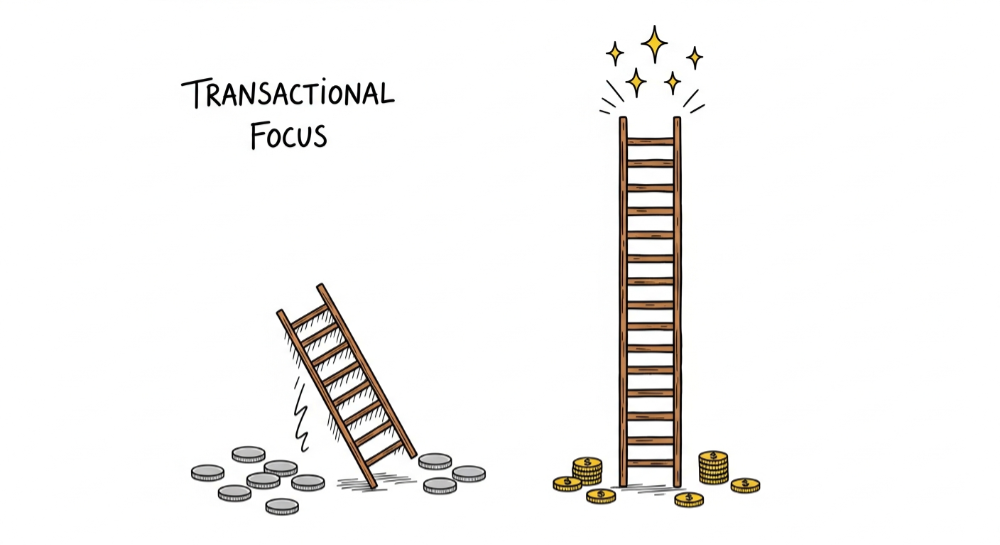
The trust ladder

Quick test.
Think of a business you'd recommend to a friend without hesitation. One where you'd say, "You HAVE to work with them," and stake your credibility on it.
Got one?
Now count how many you can think of.
Total.
Most people land somewhere between three and five.
Out of every business you've ever bought from, every purchase, every subscription, and every service, fewer than five earned the right to borrow your reputation.
That ratio tells you everything about why customer retention is broken.
Because most businesses are building for a transaction, not a relationship. They're stuck on the first rung of a ladder they've never even seen.
Let me show you the whole structure.
Before we move on, wishing you a Merry Christmas✨
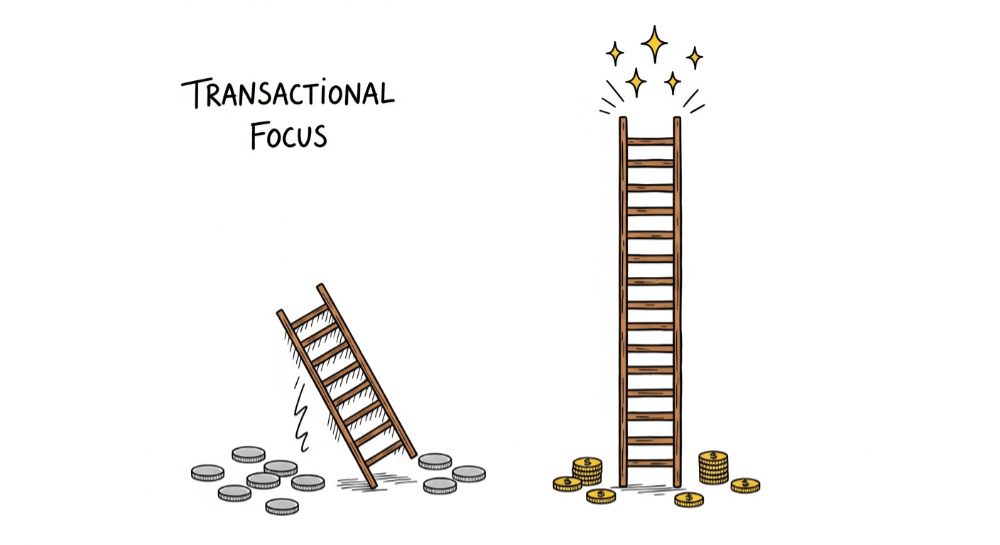
The Three Rungs of Trust
Every customer relationship sits on a ladder.
Three rungs.
Each one harder to reach. Each one is worth exponentially more.
Most businesses only see the first rung. They optimize for it, celebrate it, and build their entire operation around it.
Then wonder why everyone keeps disappearing.
Rung One: The Purchase
Someone exchanges money for a solution.
They saw your marketing. They believed the claim. They thought, "Maybe this works," and tested that theory with their credit card.
That's it.
That's the whole rung.
A transaction that proved one thing: you weren't lying.
The bar for Rung One is "not a scam." You delivered what you advertised.
The thing worked.
Congratulations. You've proven you're not a fraud.
But Rung One customer is a renter. They're not committed. One bad experience, one slightly better offer, one moment of indifference, and they're gone.
80% of first-time customers never come back.
Never.
They bought once, got what they paid for, and moved on.
Most businesses lose 80% of everyone they acquire.
That's the ladder problem.
Create a Branded Coaching Ecosystem - All In One Platform

Discover how a 7-figure executive business coach and former IBM marketing executive, Julie, boosted engagement and loyalty by turning her courses, coaching, and community into a cohesive, branded coaching ecosystem on Kajabi.
Rung Two: The Return
A customer comes back because you proved something competence can never prove.
Motive.
Rung Two is when a customer believes you'll act in their interest, even when it costs you something.
That distinction changes everything.
Competence says, "They can do the job."
Motive says, "They actually want what's best for me."
You prove competence by delivering results. You prove motive by sacrificing for someone else's outcome.
The sacrifice is the signal. Without it, you're just competent. And competent businesses are replaceable.
I watched a software founder leave $50K on the table last year.
"You don't need our premium plan," he said. "Start with the basic tier. You'll know in three months if you need more."
His sales team thought he was insane.
That company stayed for two years. Upgraded twice. Referred four other customers.
Because that one conversation proved motive. It showed he cared more about their outcome than his revenue.
Rung Three: The Referral
Now we reach rare air.
Rung Three customers don't just trust you. They stake their own reputation on you.
Think about that.
When someone says "you HAVE to work with them," they're putting their credibility on the line. If you screw up, they look bad. They've attached their name to yours.
That's BRAND.
Because a brand is when someone borrows their own reputation to recommend you.
It can't be bought.
Referral programs don't create Rung Three customers, they create mercenaries who'll switch the moment someone offers better incentives.
Rung Three is earned.
By proving motive so many times, so consistently, that a customer stops questioning whether you're on their side.
They just know.
The Numbers That Matter
This isn't philosophy. It's economics.
Rung One business:
- 20% of customers return
- Customer acquisition cost: recovered after 3-4 purchases
- Problem: most customers never make 3-4 purchases
- Reality: constant bleeding, constant replacing
Rung Two business:
- 40-60% of customers return
- Customer acquisition cost: recovered after 1-2 purchases
- Lifetime value: 3-5x higher than Rung One
- Reality: sustainable, profitable growth
Rung Three business:
- 30-50% of customers actively refer
- Cost per referred customer: near zero
- Referred customer retention: 37% higher than paid acquisition
- Lifetime value: 6-10x higher than Rung One
- Reality: compounding, self-sustaining growth
The gap isn't marginal.
A Rung Three customer is worth ten Rung One customers, and they arrive without acquisition cost.
This is why some businesses scale effortlessly while others grind forever on the acquisition treadmill.
They're not better at marketing. They're better at the ladder.
The Rung One Trap
Most businesses are architecturally designed to stay stuck.
Look at your incentives.
Sales gets paid on new deals. Marketing reports on acquisition metrics. Your board deck shows new customer growth, not trust depth.
The whole machine optimizes for getting people ON the ladder. Nobody's measured on moving them UP.
And the standard "retention tactics"? They're usually Rung One tactics in disguise.
Loyalty programs: Bribery. You're paying them to transact again. The moment someone offers better points, they vanish.
Satisfaction surveys: Competence checks. "Did we meet your expectations?" is a Rung One question. It measures whether you delivered the basics, not whether you've proven motive.
Personalization: Expected. "You bought X, you might like Y" is baseline competence now. It proves you have software, not that you care.
None of these build trust. They just make Rung One slightly stickier.
To actually move up?
You need sacrifice.
The Sacrifice Test
When was the last time you cost yourself something for a customer's benefit?
Actually sacrificed.
- Told them NOT to buy something
- Refunded them before they asked
- Fixed a problem they didn't know about
- Sent something valuable with no pitch attached
- Turned down money that wasn't right
If you can't remember the last time, you're stuck on Rung One.
Because motive is only proven through sacrifice. Words mean nothing. Policies mean nothing. The sacrifice is the signal.
The Motive Audit
Three questions. Answer honestly.
Question 1: What's your "wrong customer" rate?
How often does your team turn away money that isn't the right fit?
If the answer is "rarely" or "never," you're not proving motive. You're just taking whatever comes through the door.
Track this.
If your sales team isn't turning away at least 10% of leads, you're optimizing for Rung One.
Question 2: What's your value-to-ask ratio?
Look at your last 20 customer touchpoints. How many were "asks" (buy this, review us, refer someone) vs. "gives" (pure value, no strings)?
If more than half are asks, you're extracting value from the relationship faster than you're depositing it.
Fix the ratio.
Aim for 50/50 at minimum.
Question 3: Would your top 10 customers stake their reputation on you?
Would they look someone they respect in the eye and say, "You HAVE to work with them" knowing their credibility depends on you not screwing up?
List your top 10.
Count the definite yeses.
If fewer than 3, you haven't reached Rung Three with anyone.
The Plays: Moving Up
Enough diagnosis. Here's the playbook.
Rung One Foundation (do these first):
- Map "time to first win." How long until a customer gets actual value? Measure it. Then cut it in half.
- Build proactive rescue. Track signals that predict churn, low usage, support tickets, and silence. Reach out before they decide to leave.
- Deliver slightly early. Every timeline beat, even small ones, builds evidence of competence.
Rung Two Ascent (the unlock):
- Institute the "not for you" script. Train everyone to recognize mismatches and turn them away. Track it weekly. If nobody's doing it, incentivize it.
- Create zero-ask touchpoints. Helpful emails, resources, and check-ins where you want nothing in return. These prove you're thinking about their outcome when they're not even thinking about you.
- Make sacrifice visible. When you absorb a cost or fix something proactively, say so. "We're crediting your account because our onboarding took longer than it should have." Visible sacrifice is what proves motive.
Rung Three Endgame (the compound):
- Replace referral bonuses with access. "Your friend skips the waitlist." Status is more valuable than cash. It also proves you're not trying to buy advocacy, you're rewarding it.
- Give advocates a flag. People who stake their reputation want to feel part of something. A point of view. A movement. Give them language for what they believe, and they'll carry that flag.
- Protect their credibility. If an advocate sends someone who isn't a fit, handle it gracefully. Don't let their reputation suffer for your benefit.
The Different Game
It's not about your product being better or your price being lower
It's about which rung you're building for.
Rung One business grinds forever. They acquire, lose, replace, and repeat. They're on a treadmill they can never escape because their customers have no reason to stay.
Rung Two businesses grow sustainably. They retain. They profit. They stop bleeding.
Rung Three businesses compound. They grow themselves. Customers arrive for free, stay longer, and spend more.
The only difference is the ladder.
The Choice In Front of You
You're building for one of three rungs right now. Whether you've thought about it or not.
If you're optimizing for acquisition and ignoring retention, you're building for Rung One.
If you're willing to sacrifice short-term revenue to prove you're on the customer's side, you're building for Rung Two.
If everything you do is designed to be worth staking a reputation on, you're building for Rung Three.
The ladder exists in every business. Most founders only see the first rung because that's all their metrics show them.
But now you see all three.
What are you going to build?
--- Shashank
P.S.
Here's the exercise: Pick one current customer this week. Do one thing that costs you something and benefits them. A sacrifice. An admission, a fix, a proactive upgrade, a piece of help with no pitch attached.
Don't tell anyone you're doing it. Just watch what happens.
P.P.S.
The next time someone on your team says, "We need more leads," you'll hear it differently. You'll ask, "Or do we need more movement up the ladder?"
That's when you know.
11, PNR Nagar
Dindigul, Tamil Nadu 624001, India

No comments yet. Be the first to comment!