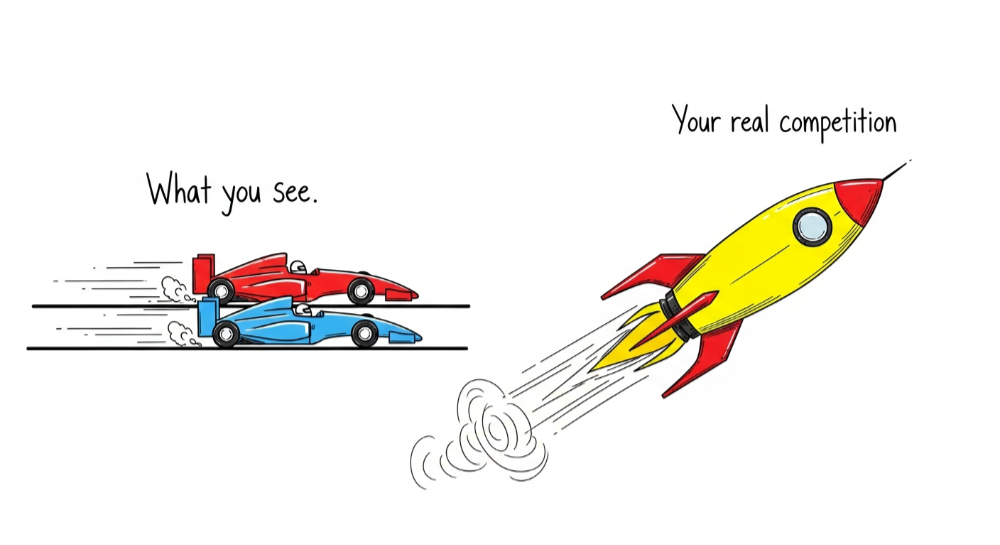
You don't know your real competition.

A couple of weeks ago during the year end break, I finished reading Obviously Awesome by April Dunford. Closed the book, stared at the wall and had a deeply unsettling thought:
Did this woman break into my apartment and photocopy my brain?
I'm not saying April Dunford, a positioning consultant with 25 years of experience and 200+ companies under her belt, including Google, IBM, and Epic Games hacked into my Notion workspace. I'm not saying she's been secretly reading every Stupidpreneur newsletter I've published. I'm not making accusations.
But the evidence is... compelling.
But what can you actually DO about the proclaimed 'AI bubble'? Billionaires know an alternative...

Sure, if you held your stocks since the dotcom bubble, you would've been up---eventually. But three years after the dot-com bust the S&P 500 was still far down from its peak. So, how else can you invest when almost every market is tied to stocks?
Lo and behold, billionaires have an alternative way to diversify: allocate to a physical asset class that outpaced the S&P by 15% from 1995 to 2025, with almost no correlation to equities. It's part of a massive global market, long leveraged by the ultra-wealthy (Bezos, Gates, Rockefellers etc).
Contemporary and post-war art.
Masterworks lets you invest in multimillion-dollar artworks featuring legends like Banksy, Basquiat, and Picasso---without needing millions. Over 70,000 members have together invested more than $1.2 billion across over 500 artworks. So far, 25 sales have delivered net annualized returns like 14.6%, 17.6%, and 17.8%.*
Want access?
[Click here to skip the waitlist →]
Investing involves risk. Past performance not indicative of future returns. Reg A disclosures at masterworks.com/cd
I picked up her book expecting to learn something new about positioning. Instead, I found page after page of ideas I've been preaching for years --- sometimes word-for-word aligned with the Stupidpreneur philosophy.
- The customer-centric approach.
- The death of static positioning.
- The uselessness of fill-in-the-blank positioning statements.
By chapter three, I was highlighting passages and muttering, "I SAID THIS. I LITERALLY SAID THIS." By chapter seven, I'd moved past suspicion into something stranger, validation.
When you spend years sharing ideas that people call "contrarian" or "unconventional" or my personal favorite, "interesting, but that's not how we do things here", you start to wonder. Am I actually onto something? Or am I just a guy yelling into the void?
Then a bestselling author comes along and packages those same ideas into a framework that the business world nods along to. And suddenly your contrarian takes aren't contrarian anymore.
They're best practices.
THE EVIDENCE FILE: EXHIBIT A THROUGH D
Let me walk you through the case file. Four specific overlaps between Stupidpreneur philosophy and Dunford's framework that made me feel like I was reading my own thoughts in someone else's handwriting.
Exhibit A: Customer-Centric Positioning (Not Founder-Ego Positioning)
**Your positioning isn't about what YOU think your product is. It's about what your CUSTOMERS need it to be.**Stop navel-gazing. Stop building positioning around your origin story, your founder journey, your "why I started this company" narrative.
Nobody cares.
Your customers care about their problems. Position yourself as the solution to THEIR context, not as a monument to your vision.
Dunford's take? Almost identical.
She argues that positioning is "context setting", the deliberate act of defining how you're the best at something that a defined market cares a lot about. Not what you care about. What THEY care about.
The reaction I used to get when I said this? "But our story is what makes us unique!" "But investors want to hear your founder's journey!" "But we need to communicate our mission!"
Sure.
And your customers need to understand why they should give you money. Pick one.

Exhibit B: Best-Fit Customers Over "Everyone Is Our Customer"
I've lost count of how many founders I've talked to who say some version of: "Our target market is anyone who needs [extremely broad category]."
My response is always the same, "If everyone is your customer, no one is your customer." You're casting no net. You're standing in the ocean hoping fish jump into your boat.
Dunford calls these "best-fit customers", the specific people who care the most about your unique value. The ones who buy quickly, rarely ask for discounts, and become your biggest advocates. She's ruthless about trying to please everyone.
Find your true believers and position for THEM.

The pushback I've gotten? "But we'll miss out on potential customers!" "But our TAM will look smaller to investors!" "But what if we're wrong about our segment?"
Ahhhhh...
A smaller TAM with 40% conversion beats a massive TAM with 0.4% conversion.
Every.
Single.
Time.
Exhibit C: Competitive Alternatives Aren't Always Competitors
This one made me actually laugh out loud when I read it.
For years, I've told founders: Your competition isn't who you think it is. You're not competing against the other startups in your space.
You're competing against Excel spreadsheets. You're competing against "hire an intern to do it manually." You're competing against "do nothing and hope the problem goes away."
Dunford frames it as "competitive alternatives", whatever your best customers would do if you didn't exist. And she's explicit that often the alternative is a spreadsheet, a manual process, or ignoring the problem entirely.

When I've said this to founders, the response is usually confusion. "But we have direct competitors! We need to differentiate against THEM!"
Do you, though?
If 70% of your lost deals go to "we decided to stick with our current process," your positioning problem isn't differentiation. It's category creation. You're not losing to competitors. You're losing to inertia.
Exhibit D: Positioning Is Not Static
I've been preaching this for years: Your positioning should evolve. Markets shift. Competitors emerge. Customers need change. If your positioning is the same today as it was eighteen months ago, you're probably leaving money on the table or worse, becoming irrelevant.
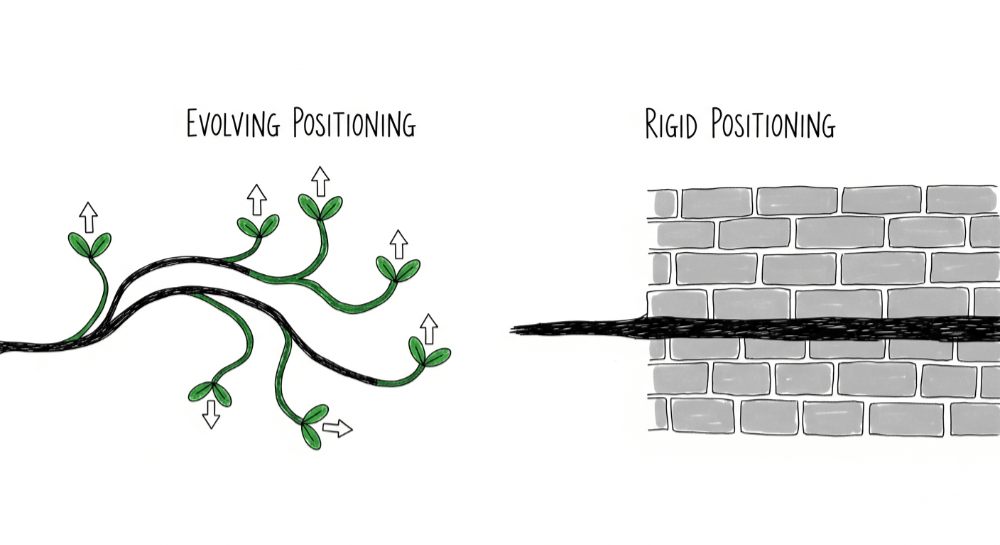
Dunford agrees. She recommends checking your positioning every six months, or after major market events.
Stupidpreneur has repositioned THREE TIMES in the past year alone. Not because I was wrong before, but the market changed. AI exploded. The creator economy shifted. New opportunities emerged that didn't exist twelve months ago.
Each repositioning was an adaptation and each one drove growth.
The old-school advice? "Find your positioning and stick to it. Consistency builds brand."
The reality? Rigidity kills brands. Responsiveness builds them.
THE EMOTIONAL JOURNEY: FROM HEIST TO VALIDATION
I'll be honest about my emotional arc reading this book.
Stage One: Suspicion. Wait, did someone plagiarize me? These ideas are too similar. This is weird.
Stage Two: Ego Bruise. Okay, no one plagiarized me. These ideas exist independently. Which means... I'm not as original as I thought?
Ouch.
Stage Three: The Reframe. This isn't theft. This is convergent evolution.
When you spend enough time in the trenches, actually working with brands, actually building positioning, actually watching what works and what fails, you arrive at certain truths. Because reality has a way of teaching the same lessons to anyone paying attention.
April Dunford spent 25 years in marketing leadership. I've spent years building and advising brands through Stupidpreneur. We've never met. We've never compared notes. And yet we landed on nearly identical frameworks.
That's a signal.
Stage Four: Bittersweet Acceptance. Look, I'll admit it --- I would have loved to be the one who wrote this book. I would have loved to be the "positioning expert" whose framework gets cited in boardrooms and pitch decks and LinkedIn posts.
But there's something beautiful about seeing your "contradictory takes" validated by someone with 200+ client engagements and two bestselling books. It means the ideas aren't just my opinions. They're patterns. They're truths that emerge from doing the work.
THE POSITIONING STATEMENT IS DEAD (AND WE BOTH KILLED IT)
Let me go deep on one idea that Dunford and I share, because it captures everything wrong with how most people approach positioning.
You've seen the template. Every marketing course, every branding workshop, every "How to Position Your Startup" blog post has some version of it:
"For [target customer] who [statement of need], [product name] is a [market category] that [key benefit]. Unlike [competitors], our product [statement of differentiation]."
Fill in the blanks. Get your positioning. Ship it.
This template is useless.
And it's actively harmful.

Dunford calls it out directly in her book that the traditional positioning statement assumes you already know the answers. It's a formatting exercise disguised as a strategic one. You're just mad-libbing your way to mediocrity.
I've been saying this for years with a different framing: Positioning isn't a SENTENCE. It's a PROCESS.
The fill-in-the-blank approach fails for three reasons:
Reason 1: It skips the hard work. The template assumes you know your target customer, your market category, your key benefit, and your differentiation. But FINDING those answers is the entire challenge. The template is like a recipe that says "Step 1: Obtain a delicious meal. Step 2: Eat a delicious meal." WHERE'S THE COOKING?
Reason 2: It creates Frankenstein language. Have you ever read a positioning statement out loud? "For enterprise HR managers who need streamlined onboarding, TalentFlow is a SaaS platform that reduces time-to-productivity. Unlike legacy HRIS systems, our product leverages AI-powered workflows."
No human talks like this. No customer thinks like this. You've created a sentence that's technically complete and practically useless.
Reason 3: It optimizes for internal alignment, not customer resonance. The positioning statement becomes a thing you put in a slide deck to make executives nod. It doesn't become a thing that actually helps you sell, market, or build. It's a corporate theater.
THE POSITIONING PROCESS FRAMEWORK
So what's the alternative? Both Dunford and I arrive at the same answer: positioning is sequential, not fill-in-the-blank.
Here's how it actually works:
Step 1: Start with your happiest customers. Not your target market. Not your TAM. Your actual, existing, happiest customers. The ones who bought fast, paid full price, and tell their friends about you. They hold the key to your true value.
Step 2: Understand what they would use if you didn't exist. This is your competitive alternative. It might be a competitor. It might be Excel. It might be nothing. But this is your real battleground.
Step 3: Identify what you do that the alternative can't. These are your unique attributes. Factual. Provable. Not "we have better customer service"---that's a claim. "We respond to support tickets in under 4 hours on average"---that's an attribute.
Step 4: Translate attributes into value. For every unique attribute, ask "So what?" until you hit something the customer actually cares about. "We respond in 4 hours" → "So what?" → "You're never blocked waiting for help" → "So what?" → "You ship faster." THAT'S the value.
Step 5: Find the market frame that makes this obvious. Choose a category that makes your value self-evident. Sometimes it's an existing category. Sometimes it's a niche within a category. Sometimes it's a new category entirely.
This is work. This is hard. This is the part that positioning statements skip.
Can you explain your positioning to a stranger in 30 seconds, without using any jargon, in a way that makes them immediately understand why they should care?
If you can't, you don't have positioning. You have a positioning statement.
And this is exactly what I teach in the brand engine as well. I first ask you to research your customers, talk to them and understand them and then come back to the positioning statement and not the other way around.

THE VERDICT: CASE CLOSED
April Dunford didn't steal my ideas. She validated them.
And that validation matters --- not for my ego, but for anyone who's been following Stupidpreneur and wondering if these frameworks actually work.
They do.
They work well enough that someone with 25 years of experience and hundreds of client engagements independently arrived at the same conclusions.
If you've been reading Stupidpreneur, you're already ahead. You've been learning these principles in real-time, applied to real brands, with real results. Keep going.
And if you've been called "contrarian" for believing that positioning should be customer-centric, that it should evolve with the market, and that fill-in-the-blank templates are corporate theater?
Welcome to the club. Turns out we were just early.
But April, if you're reading this, you owe me a coffee. ☕
Your brand philosopher,
Shashank "The Stupidpreneur" SN.
P.S.
Want me to break down YOUR positioning using this framework? Reply to this email with your one-liner and I'll tell you what's working and what's not. First 10 replies get a detailed response.
11, PNR Nagar
Dindigul, Tamil Nadu 624001, India

No comments yet. Be the first to comment!